As I walk, a lot of random thoughts drift through my head, and often I think to myself “I ought to write about that.” But in the wee hours of the morning, when I get up early to write my posts, the flow of the writing often jumps over things I had been thinking about. I just don’t see a way to fit them in, or I forget them.
So, during today’s walk (note that though I am writing this at 5:30am the next morning, for ease of reading I will, as I have throughout, write as if it were the end of the day of walking about which I am writing), when one of those thoughts came back to me again (“The indifference to a truly cold beverage in English shops”), I took out my phone and started a voice memo list of things I wanted to write about. Let’s call them Stray Thoughts.
Cold beverages
In the United States, stores large and small usually keep soda and beer in refrigerator cases with doors to keep the arctic cold in. You might frustratingly run across a bottle or can that was recently put in the cooler and so isn’t chilled, but the general idea is that you are going to get a drink that is very cold. This idea just never took in the United Kingdom (or in other places I have traveled). Here, most small shops keep the sodas and juices in an open display along with prepared foods. It is technically a cooler, blowing cool air over everything, but cool is clearly a relative term. This seems related to me to the British love of beers and ales served at a higher temperature than is common in America. We ice the daylights out of everything. They embrace the fact that a higher temperature allows you to taste more flavors. This may be one reason I embrace cider on my walking trips: They do chill most ciders, particularly sparkling ones (as opposed to still ciders, which are sometimes served at a higher temperature). I have no profound cultural insight about American fetishism of the refrigerator or British indifference to the icy chill. Just noting it.
 The Gay Teen in Rural England
Eating in one of my stops the other night, I was observing, as one does when one eats alone in a strange place and doesn’t like to stare at one’s phone like a jerk all through eating, the people and the social dynamics of the place, which was a pub but with enough tables to be more of a restaurant. The place had a robust staff, with a barkeep, two waitress and two back waiters (the ones who don’t take your order but deliver your food and clear). One of the back waiters was a kid of about 18. He had the short-around-the-sides-and-back, long-on-top haircut that in some variation has been more or less fashionable for young gay men for, I dunno, two decades. The cut that gives you a big Nike swoosh of hair down over your forehead. He’d tinted or dyed or highlighted (what am I, a beautician?) the front to blond, though most of his hair was brown. When not bussing tables or serving food, he perched against the wall with one leg pulled up so the foot was flat against the wall, surveying the room in a stance that looked exactly like someone at a club trying to look cool. When he did serve food, he walked with a shoulders-back sashay that made no apologies. This kid was telegraphing a bold, clear identity that we used to call effeminate, or sissy, or swishy. (There were less kind words for it, of course.) And I thought to myself, how tough must it be to be a gay teen (I am speculating, of course, on his sexuality based on his affect, but if he isn’t gay, he’s still presenting in a way that is not the usual for small-town rural England) in a town with a hundred residents, many spread out. How strange must it be to see a whole larger world of LGBTQ identity on television and the internet, but have to take a bus to a train to get to a city of any size, and that city is Exeter? Brave kid, dyeing that hair. Brave kid, serving food and bussing tables like he was on the fashion runway. Between observing other people (let me reassure you this wasn’t creepy stalker stuff; I was observing all sorts of people), I was reflecting on how different my own teen years were. I was not flamboyant, or bold. I hadn’t worked out how to deal with my sexuality, so I just let it alone for a while. I didn’t meet open, out-loud gay people until college. And even then, I was circumspect and not one for big affect. So I really respect the self-assurance of teens who have worked it out. Times, they have changed.
 My Gothic Short Story
While I was walking today, I kept returning to the vague sense of Gothic horror from my walk across the windy moortop passing by barrows. I started imagining my Gothic short story.
For Professor Sartin, the barrows of Devon were a private obsession, quietly hidden from his colleagues. His area of scholarly focus, in which he careful detailed work was received with respect, was the economics of 18th Century tin-mining. He was in fact regarded as something of an authoritative voice on the shifts in mining that occurred in the 1760s during a period of economic uncertainty. But in the privacy of his chambers, discreetly tucked on bookshelves behind an armchair, was a collection of books and atlases and manuscripts on the Bronze Age society of Devon and the barrows of the moors. On quiet evenings, he would pore over maps and illustrations. In the summers, when his researches would take him to Devon to dig into local town records for clues to the changing ownership of mines during that unfortunate 1760s upheaval, he would carefully plan his trips to give himself excuses to be near the sites of notable barrows. And so it was that he found himself in The Wanderer’s Rest, a pub nestled in the small, nearly forgotten town of G—ford, nestled in the hillside below Alfred’s Top, which boasted a particularly notable but puzzlingly unexcavated barrow….
Retirement
The problem with retirement as an idea is that I want to do all this adventurous stuff like walking while I still have the energy and the knees to do it. (This is not exactly an original insight, of course…) I’m not complaining about all the wasted years spent chained to a desk. I’ve had a very strange career, or careers, or set of jobs, or whatever it is that I have had. I was able to drag out graduate school and live on teaching and writing film reviews and living on the cheap and saving nothing toward retirement for a long time. Then I was able to do some teaching and writing advising and reviewing after graduate school, doing fun things as time and money allowed. I finally held down a fulltime job in my forties, and I’ve had my share of adventures, walking all these paths in the United Kingdom and Ireland and Switzerland. But I would love to be able to take a leave of absence from work for a few years now, and just do whatever. My practical side notes that with current income and cost projections, I won’t be retiring for at least another 15 years, and even then I might have to “consult” in retirement (if only any of my skills were things people wanted consultation regarding…). I know I can’t swing the economics of it, but it’s fun to fantasize.
Tiny Cars
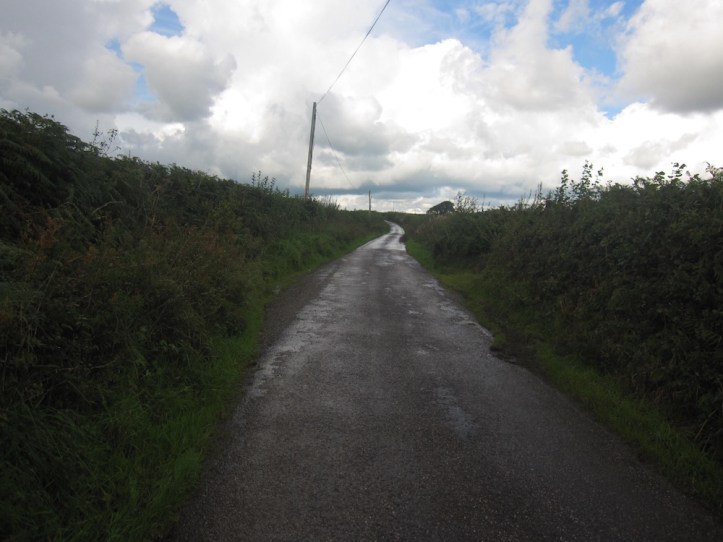
The British have embraced small cars in the same way that Americans have embraced SUVs and crossovers and other tank-like vehicles. Of course, this is partly due to the much higher price of gasoline in The U.K. (and Europe). But walking down country roads makes it clear that the embrace of tiny cars (and I do mean tiny—some of these cars make a Cooper Mini look like a bus) is partly a very practical response to narrow roads carved between high hedges or stone walls, where meeting another car coming in the other direction is often a test of your awareness of the exact width of your car. To call some of these roads even single lane is flattering them.
So Many Smells
Most of the English dogs I have met along the trails are incredibly well-trained. They don’t bolt off into the fields after sheep, they don’t wander off far ahead of their owners, and when they meet a stranger, for the most part they don’t even stop to sniff you. If they are so bold as to want to acknowledge you and say hello, they will check back in with their owner, making a little eye contact before approaching the stranger. Then they don’t jump or root around your feet and legs taking great huge drags of scent; they sniff a bit and look at you. My boots and legs are, of course, layered with miles of smells, of cattle and sheep and maybe even another dog. When a dog does come up and take a whiff, my standard line, aimed both at the dog and the owners, is “So many smells!” It always gets a laugh from the owners, and often starts a short conversation of the ‘how far are you walking today’ and ‘where are you from’ variety.
Fun with Camera Settings
I carry a real camera, not just an iPhone. One of the silly pleasure of my camera is the multiple settings for taking pictures: “Sunset,” “Foliage,” “Snow,” “Beach,” “ISO 3200,” “Digital Macro,” “Nighttime Snapshot,” etc. Sometimes I like to play with the settings and try the same photo in a bunch of different settings just to see what happens. Check out this slideshow of a tree.
That’s how my day went, with sixteen miles of walking (long, long stretches on country roads made the walking fast, so it only took me a little under seven hours). Oh, and it hailed for about thirty minutes, while I was, by an incredible stroke of luck, walking down a greenway under the cover of trees so that I didn’t get the worst of it. But it was just a ton of hail, as you can see.
Two more days of walking before I reach the sea.
 ramblinghank
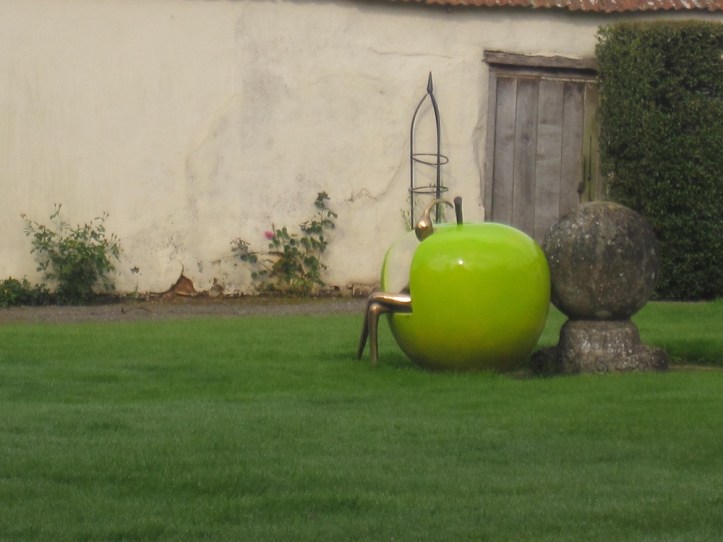
Sounds like you could use a Diet Coke properly immersed in a tub of ice! Love the green apple sculpture. That’s a beautiful and unexpected photo.
Hank as I drink my ice cold Diet Dr. Pepper (no Tab) today, drive my rented Hyundai Sonata (small by US standards) and wonder about my own retirement on my walk this morning I will think of you! What a lovely post!
When is the next installment of “Professor Sartin and the Horror of G—ford Manor”?