The forecast called for rain all day, and when showers while we were out to dinner last night, it was a bit discouraging. But after a night’s sleep, with the gentle snoring of another B&B guest faintly audible (no, it wasn’t Karen!), we awoke to a morning that looked wet and blowy, but not aggressively torrential as we had feared. Over breakfast, Karen and I looked at maps, pondered the suggestions of our host Jenny: a ride to Cadgwith to cut off four miles, a ride to Kennack Beach to cut off even more, or a ride to Coverack, the last point where it was easy to get or retrieve anyone before the last five miles to Porthallow. Or of course we could be crazy and do the whole 15.5 miles, but the trail guides noted that those first four miles are always a bit wet.
We decided to take Jenny up on the ride offer, and so Matt (Her boyfriend? The way he talked about the house-“Jenny doesn’t own it, she’s a tenant for people who live out of the village, but she does all the upkeep…” seemed not quite husbandly) drove us down tiny country roads and chatted happily about weather, and upkeep on an old house, and fishing rights. It was really a nice start, and he firmly declined our offer of money for the petrol (I tried to make it feel like less of a transaction by stressing ‘for the petrol’). And off he went to whatever oddjobs he had around the house, and we started from the lovely little fishing village of Cadgwith.
We’re on the eastern side of the Lizard Peninsula, with the force of Atlantic weather blunted by the land, and the whole day’s walking (which wasn’t as much as planned) felt more linked to civilization, with sightings of houses and active farm fields all along the way.
However, this side of the peninsula is also more ups and downs on paths that are tight and mostly dirt. Though the predicted rain held off all morning, it had been raining in the night, so we faced a muddy, mucky, squishy trail that made a slip here and there inevitable. At least that’s what I tell myself as I look at the seat of my hiking shorts, which got the mud of two good slips and sit-downs on downhill bits. The ankle is recovering bit by bit, but still makes me slower and more tentative and less agile. But Karen also took a slip and slide sit-down once, so I comfort myself that it wasn’t just me.
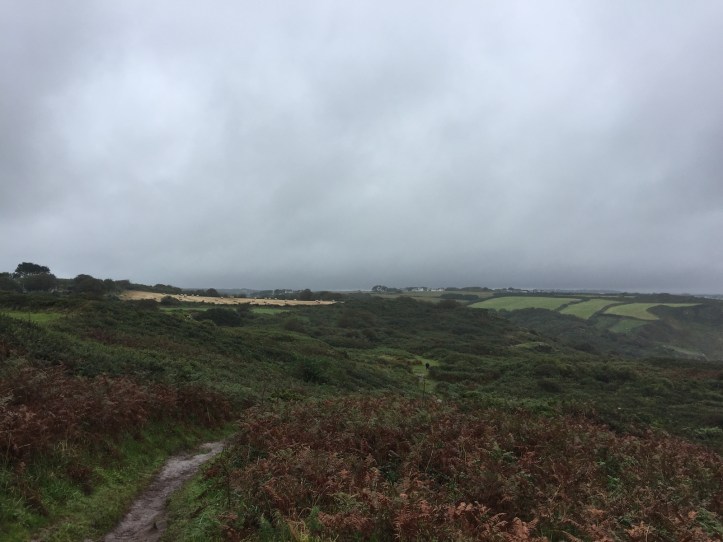 The views are beautiful, but less hugely dramatic and more cozily beautiful (though cozy seems not quite right for these big natural views) than what we were getting yesterday and before. The ascents and descents into coves aren’t quite as high, though sometimes they seem steeper.
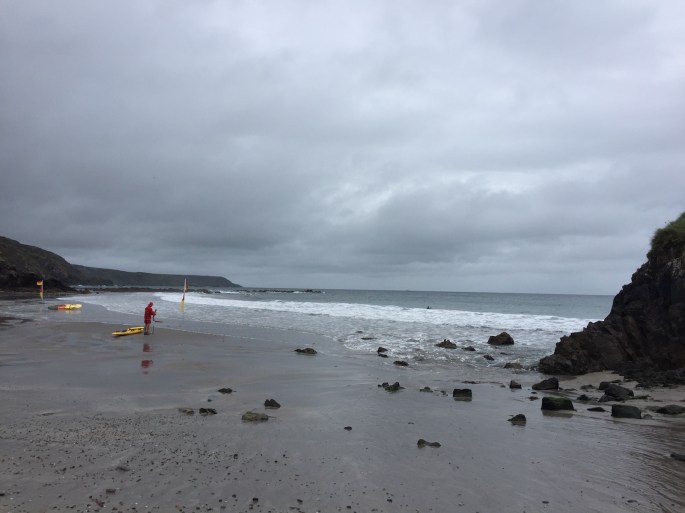 We passed by a surfing school at the little beach at Kennack, where even on a cool Friday, there were a few surfers out in the waves. Otherwise, we saw very few people today, perhaps half a dozen before getting to Coverack. We’ve settled into an easy rhythm of talking sometimes, but just walking in silence for long stretches with the occasional warning “Stinging nettles” or observation of something interesting “Look!” to punctuate the quiet.
The morning passed quickly, and though I felt like we were moving at a reasonable pace, we didn’t make it to Coverack until around 12:30. There was a very long descent on a steep, narrow road into town, and just as we got to the bottom, the forecast rain, at last, started to fall. The sky had been lightly overcast, but in the ten or fifteen minutes it took to descend that road, the cloud cover had thickened to that heavy low cover that could mean rain for twenty minutes or three hours.
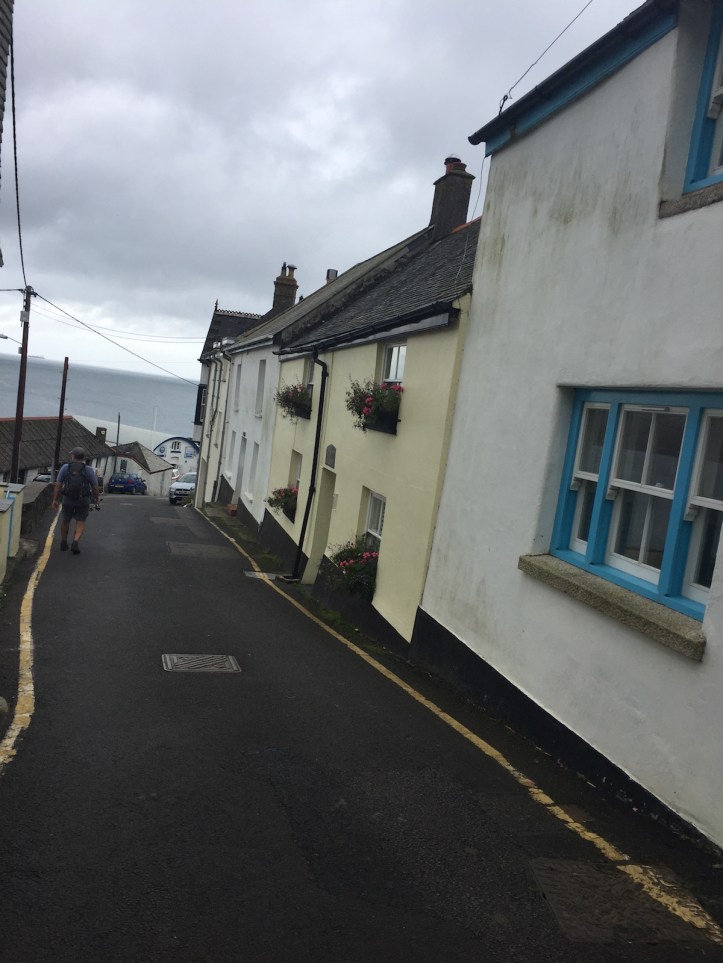
We ducked into the Coverack Village Store, which sells a few groceries and does coffee and hot chocolate. The big window looked out on Coverack’s beach, with a good view of how wet things were getting. There were a few people in the shop having a coffee, and we got their opinion that it must be quite muddy ahead on the way to Porthallow.
A little debate yielded the decision that walking five miles in mud and rain was a fool’s errand, so we got out our cell phones. Jenny had made the offer that if we got to Coverack and felt we needed a lift to Porthallow, they’d be happy to do that. I had Jenny’s number, but my reception kept going in and out. I tried her a few times when I did have reception, but she was out. So Karen tried her phone reception, which was for some reason a bit better, and we investigated the bus options. There is a way to get from Coverack to Porthallow by bus, with a transfer somewhere called “The Square” (which I imagine is a big bus change point in a town somewhere in the middle of the peninsula), and the schedule showed a bus at 1:40pm and another at 4:30. Oops, it was 1:45 as we determined this. So, Plan C, we got the card of a local taxi company from the shopkeeper and ordered a taxi to take us to Porthallow.
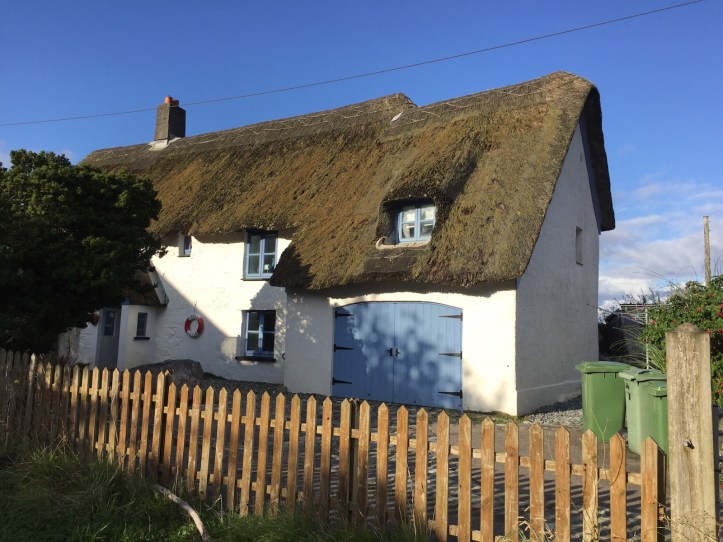
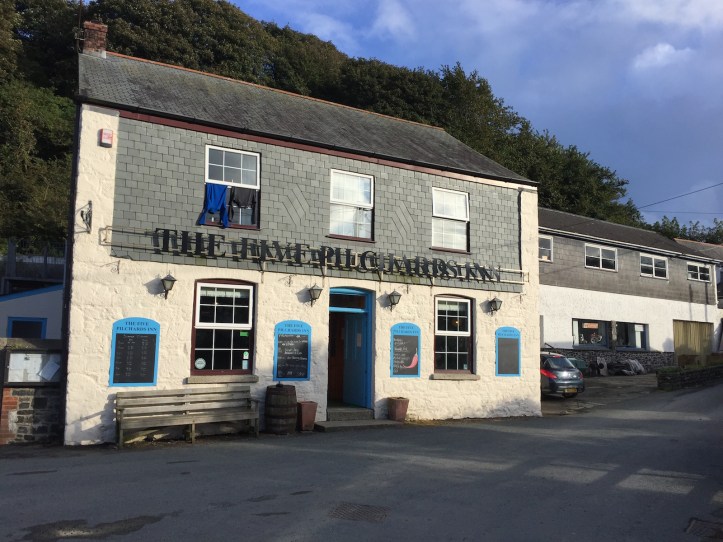
If you know anything about travel, you know the punchline. The rain started to thin out, and by the time the very cheerful, chatty cab driver (she and I regaled each other with tales of getting lost walking in fields) got us to Porthallow, there was no rain and little hints of blue sky teasing us. Oh well. Showers for scrubbing off mud, naps and reading, then dinner in the very nice Five Pilchards Inn pub, which is tiny and loaded with fishing paraphernalia and was really crowded on a Friday night. We both had delicious fresh crab salad with lots of green salad. Yum.
 Tomorrow, our last day walking together before Karen leaves and I go into my solo walk across the moors, is a big one. Eighteen miles, with two ferry crossings that have to be timed to the tides or else you walk across tricky sands or add even more miles. Here’s hoping the rain gives us a break.
 ramblinghank
Excellent reporting Hank! I will say that my “slip” involved getting an entire leg coated in mud!