Corrections
I’ll start with a correction right up front. Many respectable publications will bury their corrections a few pages in. The Sunday New York Times Book Review section drops them at the end of the Letters page, where pedants go to die on the hill of outrage that someone should snidely suggest in a book review that Lytton Strachey was ‘a lesser member of the Bloomsbury Group,’ when of course Strachey’s book “Eminent Victorians”…’ etc. I am putting my correction right up front. Here goes.
On day two, I said I was climbing the escarpment of the Cotswolds, and then I went into a bit of pedantry myself about the land’s leading edge of a geologic formation. Well, at breakfast today, my rather loquacious B&B hostess, upon hearing me mention the Costwolds, said roughly ‘but you’ve come from Stratford? You haven’t been in the real Cotswolds. Chipping Norton isn’t the real Cotswolds. That’s the Oxfordshire Cotswolds. Everyone wants a bit of the cache of being in the Cotswolds, so they use the name.’ I’m writing ‘Oxfordshire Cotswolds’ with just a hint of sarcasm and disdain that my hostess put into it. Can you hear it?
She was very chatty, and seemed oddly invested in telling me about the birds we could see using the feeders in her back garden. Most B&B hosts mostly leave you be, but she pulled up a chair, poured some coffee, and set to, punctuating her detailed account of the coloration of young versus mature goldfinches with the occasional question about my travels. But under that chattiness, she had a penetrating intelligence and an ear for language. The Oxfordshire Cotswolds. Or when I said I’d slept like a stone, she gave me a sly look and asked “And how does a stone sleep.” I feel like the outer narrator of Wuthering Heights describing Nellie Dean, the chatty woman who tells him the story of Cathy and Heathcliff. So bear in mind that, like him, I’m being a bit condescending in describing her while appropriating her story, in this case her correction about the Cotswolds and her neat observation that the well-off Oxfordshire wants to be the rough-and-tumble scenic Cotswolds. So, correction noted. I was on an escarpment, but not the true leading edge of the Cotswolds, not on the escarpment. I was a ripple in the land set back a bit from the true edge. Think of the way water ripples when you drop a stone in a still pond. Big ripple, then diminishing ones. This is the same sort of thing in reverse, I think—with the motion going toward the bigger ripple. The leading edge, the big ripple in the land, is where one part of the land pushed up. Then there are lesser ripples set back a bit, pushed after the big edge. Enough of that. I was wrong. Further research on local geological history is called for, etc.
Notes
On Language:
The walking guide writers have a touching faith that the users of the guide (I’d hardly call us readers, since our reading is so utilitarian) share a certain common vocabulary. The guide will instruct me to go diagonally across the field toward the horse chestnut tree. A horse chestnut tree could fall on me, horse, chestnuts and all, and I would not be able to say with confidence that it was in fact a horse chestnut tree. The idea that I would recognize one from a distance is charming but daft.
The guide talks about going into a plantation, which is a word any American will find layered with bad associations. But in this usage, a plantation is a stand of trees that isn’t as big as a forest or a wood (I’m still not sure if those two are interchangeable in guide lingo), but it’s bigger than a cluster of trees. So, plantation.
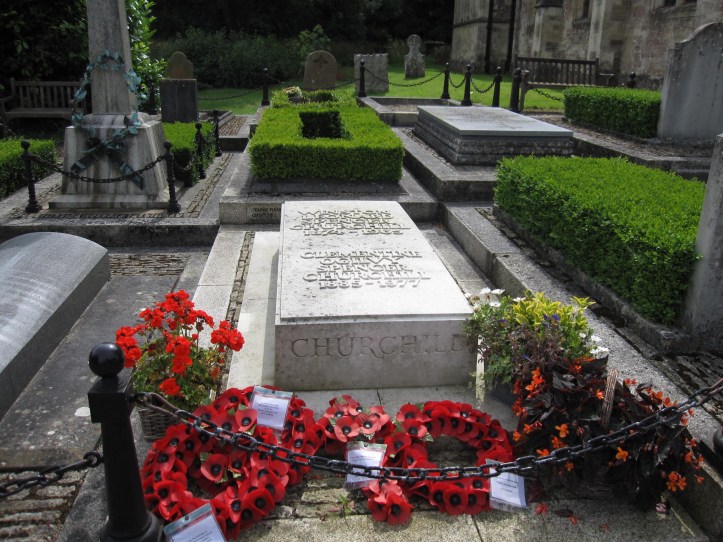
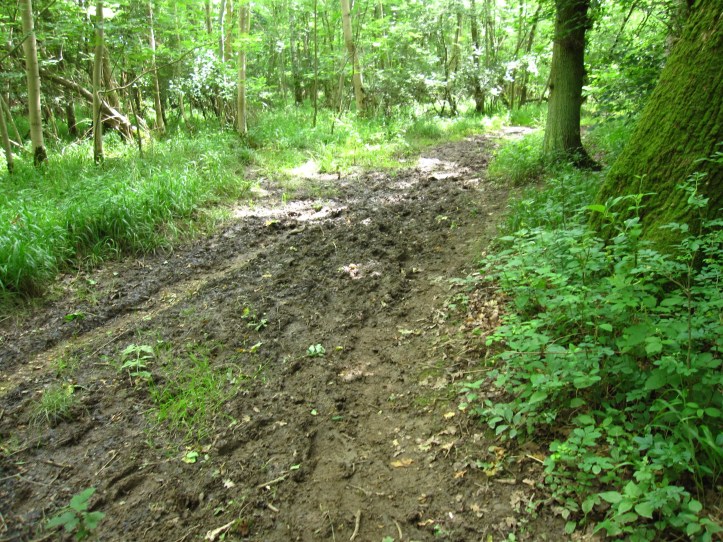
One example of the authorial assumptions about shared familiarity with terminology that charmed me inexplicably today, after I’d walked away from Blenheim and past the small churchyard where Winston Churchill has rather unexpectedly come to rest (Didn’t you assume he’d be buried in state in London? I certainly thought that when I came to this little church with a discreet tombstone) and after I’d navigated a seriously muddy stretch of path through a wood (bigger than a plantation!) that had me thinking how much my sister and sometime walking companion Tracy would have hated it, since she doesn’t like walking through squelchy mud, was the description that stated that I should walk along the edge of a field toward a charming Dutch barn. (Woof: That was a Jamesian sentence!) As opposed, I smilingly said to myself, to a Belgian barn? Or a French barn? What makes a Dutch barn so distinctive?
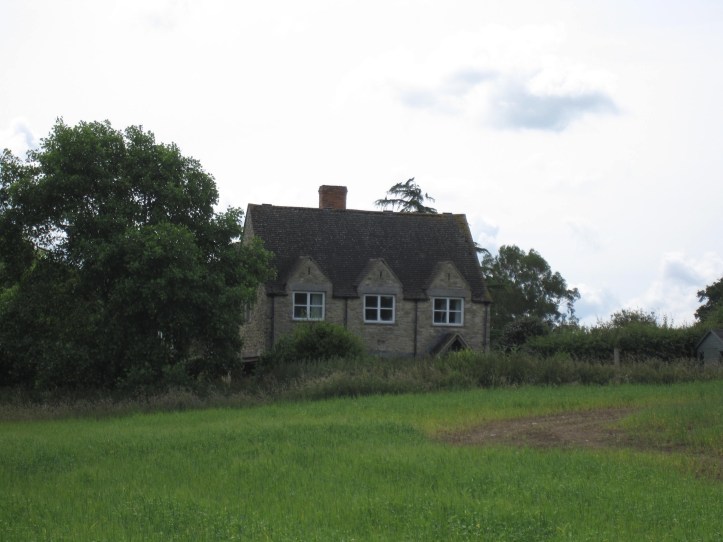
Is the building in this photo, the only one toward which the path was heading, a Dutch barn? It might be, though I determined as I passed that whatever it had been, it is now functioning as a house. Remember, my cell phone and my magical link to the answers to all questions stays in the upper pocket of my daypack, and it’s mostly switched to non-receiving airplane mode to extend the battery life, so if I had wanted to research Dutch barns on the trail, I’d have been stopping alongside a field of recently planted crops, undoing the spring clips for the straps across my waist and chest, easing the pack down to the ground, digging out the phone, turning it to normal mode and hoping I was getting enough reception to load the internet and do a Google search for Dutch barn. And what would I have gained? I had more fun imaging the varieties of barns from various countries and their distinguishing characteristics.
On Getting Lost:
I’ve noted before that sometimes on the trail the directions confuse and I, or I hope I can generalize and say “you” or “one”, get a bit muddled. But today I had a true episode of trail guide failure and feeling…not lost exactly, but that the trail was somewhere nearby, and I might be on it, or I might just be on a roughly parallel path through a field near the path I want. On a bit of trail that should have taken about five minutes, I spent about twenty or maybe even thirty minutes walking paths in a set of fields, trying to find something that matched the guide description.
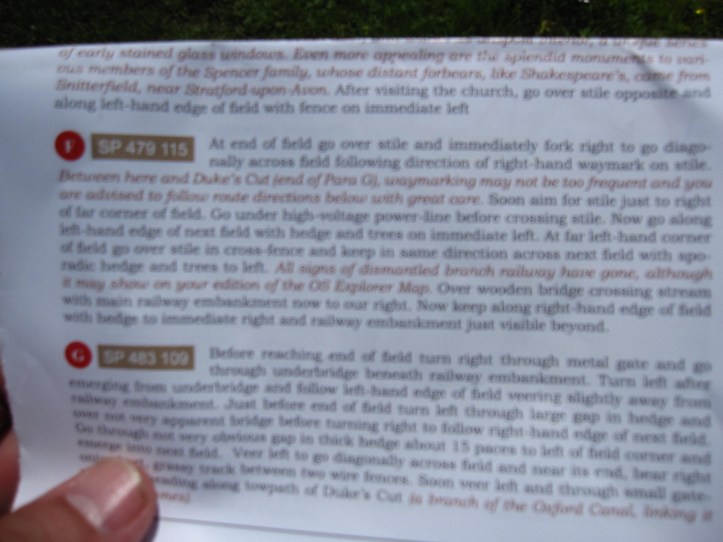
The guide is either simply incorrect and the path has changed in the last few years or I had an experience of massive reading comprehension failure. I came to a gate leading from one field to the next. A Shakespeare’s Way marker with arrow pointed me roughly ahead and a bit to the left, which matched a worn path in the lefthand edge of the field. But there was another path taking a hard right around the other side of the field, toward an electrical power line tower. The guide said pretty clearly that I should be going toward the tower, under the power wires, over a stile into the next field to the right. The path marker contradicted this. I went to the right, but there was no stile, only an opening in the hedge. Was a fence and its stile removed? I tried crossing into that field, but the only path there didn’t seem to match the guide, so I stayed on the path in the first field, thinking that stile might be further along, after the electrical tower (though the guide would surely have mentioned going right next to the tower, having mentioned going under the wires?). It brought me all the way around three sides of the field to the path I had not opted to take, and there in the corner where I’d have been in a third the time had I followed the waymarker, was another gate through a hedge with a Shakespeare’s Way marker.
This was clearly the path, but also clearly did not match the guide description. It got only worse in the next two fields, divided by more very tall hedges. No way markers, but big gaps in the hedges and paths splitting off. Then a gate to go under a railway line through a little muddy tunnel. It had a marker on the gate, but at the other end of the tunnel, I could see no path. I was trying to match up fields with the guide description, and it did not mention going through a little tunnel at all. I thought the route must have changed, but at what point was I? Was that marker on the tunnel gate wrong?
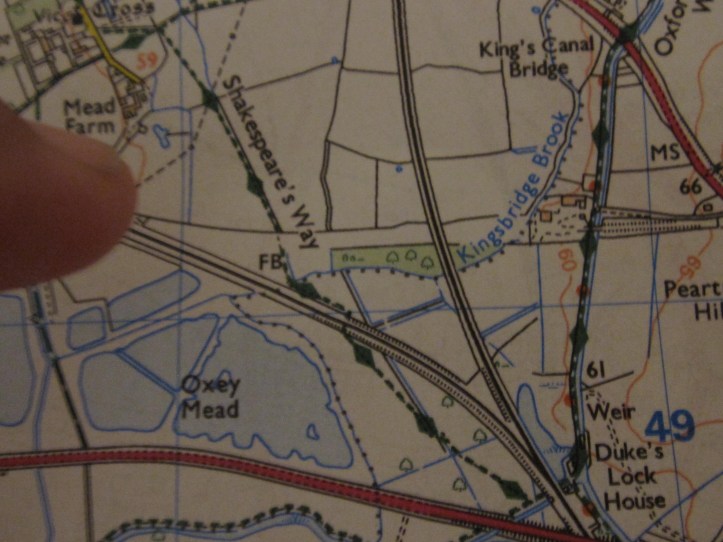
On the photo of the map, you’ll see two black lines converging in the lower right. Those are railway lines. I ended up in the field just above that coming together, facing a locked metal gate across clearly active railway tracks. (I was up closer to the green area with tree icons, where you see a blue double line on the righthand side beyond the railway tracks- the gat must have led to that little access road.) I contemplated climbing over the gate and crossing the tracks, because I couldn’t quite work out where I was. It wasn’t as easy to see from ground level as it is to describe it now that that was where I was. Finally, I went back to the tunnel, assuming that waymarkers don’t lie, and went into the grassy field on the other side of that railway. Sure enough, by walking about ten yards into the field, I could see the path again, made invisible from the tunnel because it was overgrown. That, my friends, is trail-finding. Not intelligent Boy Scouts trail-finding (I’d have consulted the ordnance survey map sooner and figured out the relationship of fields sooner if I were really genuinely good at this), but I didn’t starve to death in a grassy hedge-enclosed field in the middle of England, so let’s count this as a win.
On Memory (three shortish observations):
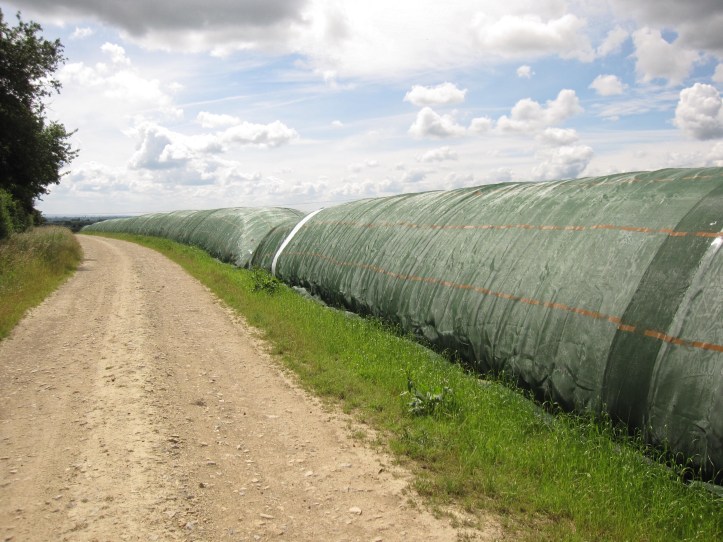
1) Memory has been on my mind today at a lot of levels. I was walking along one bit of path that was particularly rocky, with big rounded rocks pushing up to make the path frustratingly uneven and unpredictable. Bring down your foot wrong on one of those rounded rocks and your foot and ankle tell you that you’re asking it to make weird adjustments with every step. While walking on this stretch, I had the most vivid memory of a similar experience of walking on uneven ground on a previous trip. It was a memory without much context. I can’t tell you if that rocky bit of path from my previous walk was in the Cotswolds or in Wales. I know I was walking alone, so it wasn’t on my trip on the Coast to Coast path with my sister. I can’t tell you much about that rocky stretch of path except that it passed by some tumbled-down metal farm buildings on the right. Also, it’s possibly linked in my mind with arriving at and walking along the edge of a golf course. It’s so specific. But unlike the memory Proust gets from the madeleine, it’s not a whole history. It’s a fragment. It’s like a fifteen-second video clip that I can put on repeat, one that is similar to the rocky bit of path I am walking now. But why did my memory store that set of details about the metal-sided farm buildings? And is the golf course association accurate or a false trace?
2) The walking guide, in that way that travel guides do, informed me at one point that I would soon catch glimpses of Oxford’s “dreaming spires.” I knew it was a quote from some writer describing Oxford, but which one? That lodged in my brain, and while I didn’t actively think about it, for the next half hour or so it must have been kicking around in my brain, because after a while, I asked myself “Thomas Hardy?” Why I wondered, did my mind bring forth Hardy. So I framed out an argument. “Jude the Obscure” has to do with Oxford (I’ll admit now that, having done a bit of Googling just now, Hardy fictionalizes Oxford as “Christchurch” but I’d forgotten that). It must be, I thought, that my brain pulled out Hardy because I once knew this fact, and the phrase “dreaming spires” might even be in “Jude the Obscure.” Nope. Once I got back to the world of internet connections, I checked and found that “dreaming spires” was a bit from Matthew Arnold, through whose literary critical essays I dutifully plowed at some point in my education, but whose ideas have left no trace at all in my memory. Except that line about dreaming spires, which I mis-attribute, much to the dismay of Matthew Arnold’s indignant ghost.
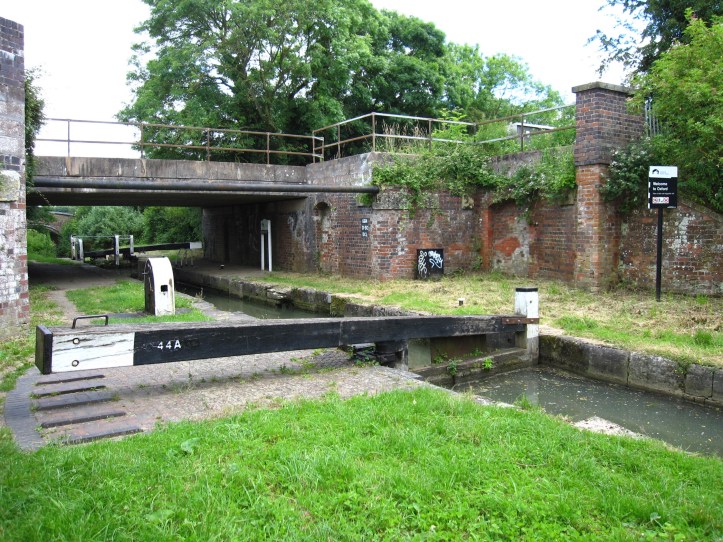
3) I was actually in Oxford long ago, living there for a fall term on a program from Stanford when I was an undergraduate. But as I tried to dredge up memories of Oxford while walking into and through the city, I found I have few memories of Oxford itself. I remember trips away from Oxford that I took with friends, to Scotland and Ireland. I remember field trips for a course called “Archeology and the Making of the British Landscape,” taken with the very small class (were there five of us?) in the professor’s car. He was an Oxford don, clearly doing this course for visiting Americans to pick up extra cash, but I do remember cool field trips to little raised mounds where ancient villages had been, and I remember visiting the White Horse at Uffington. And I remember one of my other classes, a lit class with George Decker, a charming but 50-ish fusty Stanford professor with dramatically long untrimmed grey eyebrows, a hearing aid and a demeanor somewhere between Garrison Keillor and Droopy Dog. He was deeply uncool, but I liked him and I liked the class. That included Ford Madox Ford’s novel “The Good Soldier,” with its narrator recalling “the saddest story I have ever heard,” which turns out in some sense to be the story of his friend Edward Ashburnham but in another sense is in fact the narrator’s story being told by misdirection.
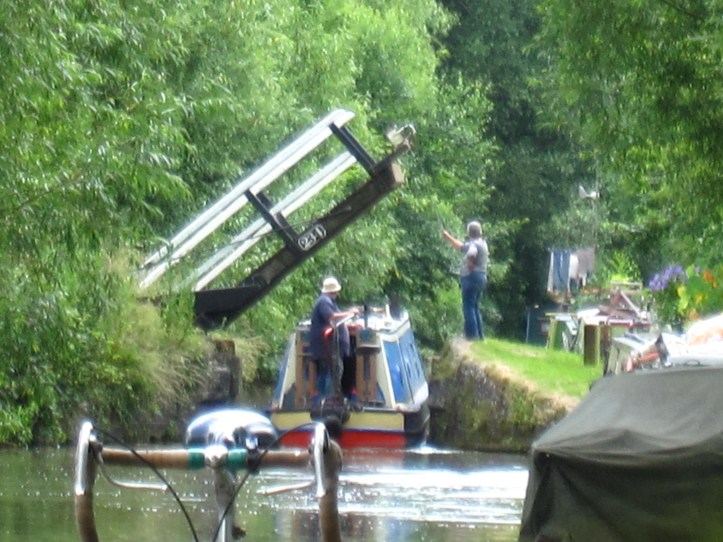 The narrator John Dowell tells the story of Edward’s marriage and infidelity, but it’s clear that the narrator is telling the story out of his obsession with Edward, an obsession so deep that by the end of the book, after Edward has committed suicide, John has bought Edward’s house and lives there, taking care of Edward’s now insane mistress. It’s pretty lurid and pretty great. My obsession with that novel lasted a good six or seven years, and I wrote papers about it for three different classes (three distinct papers, I should note). I was fascinated by the idea of narration, telling the story of someone else more interesting than the narrator, as an act of appropriation.
In those years when I was assuming I’d be getting a lit PhD (I got sidetracked into film). I was looking for a dissertation topic, and I was interested in this particular subgroup of “unreliable narrators,” the term usually applied to the narrator of “The Good Soldier.” That didn’t seem to me to get to the heart of the matter. It isn’t that we can’t trust John, the narrator. The interesting part to me was that he’s a rather boring person who tells the story of a more fascinating person with whom he is obsessed, in the process making the story his own. This idea of taking on someone else’s story led me to “Wuthering Heights” in which the outer narrator tells us about meeting Nellie Dean and the story she tells about the infinitely interesting Heathcliff and Cathy. Early in the book, when he’s getting ready to go into the story Nellie tells, he says, if I recall correctly, something like “I’ll do the story in her voice.” Not “Here’s a transcription.” He’s doing her voice, appropriating the story. I am remembering all of that now as I write. It comes back crashing into my mind, though I haven’t read either “The Good Soldier” or “Wuthering Heights” in at least twenty years. Strange thing, memory.
Queries
What do you want to know that I am leaving out? Not the romps with strapping farm lads and dashing Oxford dons (This isn’t that sort of blog, and I don’t have those sorts of adventures), but what am I leaving out? What do you want to know about this walk? Do you really want more detailed description of the trail? Personally, I find that as boring as the walking guide itself. “And then there was another field, in which you will find an octagonal building built in the late 18th century buy the lesser architect Bunting Smedley-Jones.” It’s a series of notes on walking past, alongside, over, through and sometimes under things. Is that what you want in a blog? I’m trying instead to give you my state of mind. In the old days, people who traveled kept journals, and the more egomaniacal among them later published them. Now a traveler like me can keep a blog. But these are two quite distinct acts of writing. A journal published by a reputable house is, if you’ll forgive a weird analogy, like a radio broadcast on FM. The message goes out, but it’s pretty much one-way communication. A blog is more like ham radio: I write with the expectation that I have fairly immediate readers, and that we are in some sort of dialogue in the comments. (Of course, ham radio asks for simultaneity—both parties on the radio talking back and forth in real time—while a blog has a lag. So the analogy breaks down. So sue me.) A blog is, to move to a closer analogue, like a more personal post on Facebook. Not the kind of post that is roughly “Here’s a link to an article that affirms my personal and political convictions. Comment if you dare.” (If you follow me on Facebook, you’ll note I don’t do much of that. I self-promote with links to my 10 Things to Do column, and I post about thoughts and feelings, or I note bad headlines or bad grammar in reputable outlets like the New York Times.) A blog, or at least this blog, is almost inherently a cry for love. Like my post. Read my blog entry and comment. Raise my viewer statistics on WordPress so I know I am loved.
 Final note: This rather rambling and off-topic post is titled Notes and Queries. I came up with that on the path, thinking only that I had scattered thoughts to post. At the end of the day, I did a Google search to find that good old memory was playing tricks with me again. Notes and Queries is the name of a literary history journal published by, wait for it, Oxford University Press. It’s the sort of journal where you’ll find literature nerds of the truffle hunting variety posting articles about the summer Emily Bronte spent time picking elderberries, explaining the odd reference in “Wuthering Heights” to the specifics of a berry-picking party.
 ramblinghank
Hank,
Thanks for blogging! No requests from me for specific content. You’re transporting a top rate, modern american educated mind, that happens to be particularly adept at written communication, around ancient paths of England. Anything that piques your interest, or inspires you to write, is fascinating to me. As you continue walking, what interests you will evolve, and that will be interesting also. it would be more fun to saunter around with you and debate the virtues of Dutch vs Belgian barns, but reading your blog will have to do for now! Tracy is getting really excited to join you! Anything special she should bring over to you?
I am also fascinated by memory, even while my own develops more and more lacunae (you inspire me to use fancy language…). How does a network of on/off switches store and re-present colorful visual imagery? Or aural memories that sound so realistic when you listen to them in your mind? So much we don’t know yet about the human brain…
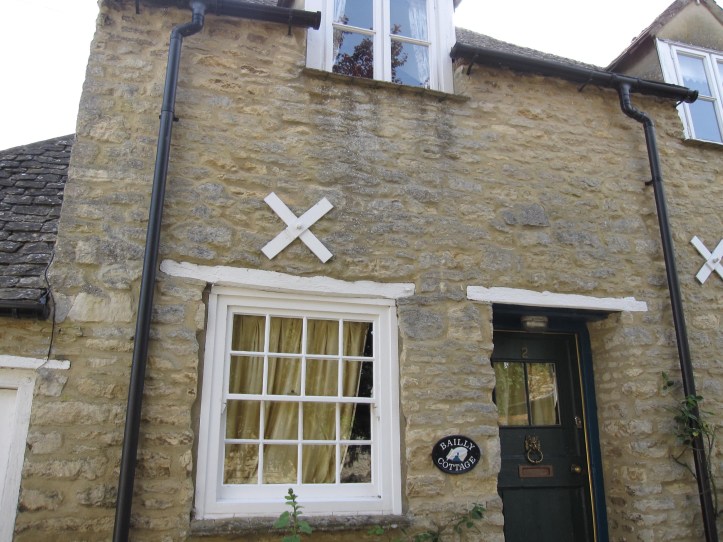
The exes in your photo look like what I would have called bolts, but are apparently called tie rod washers. If so, you should be able to walk around the building and see another one on the other side. The tie rods help keep stone or brick walls from bowing outwards. The “washers” are frequently star or S-shaped, but I wouldn’t think wood ones would last very long. Maybe the wooden ones are decorations of some sort.
you haven’t blogged about blisters and chafing, which I’ll take as a good sign -hope you had a good walk today!
Tim
Ah ha! Tie rod washers! I bet the exes that look like wood are in fact just metal painted white, like those in this photo. Now I can imagine long rods running through the building. Tracy should bring her natural gift for being social with strangers, since part one of this trip is such a solitary and internal adventure.