You might assume, given the name Offa’s Dyke Path, that this trail would follow the dyke, but you’d only be right part of the time. The trail starts on the dyke (see Day 9), but after seeing bits of it early on, I haven’t seen much fortification for days. The simple truth is this: The dyke was never fully completed as a unified line; was never meant to go all the way from the south coast to the north (it was only about 100 miles that covered the border of Mercia and the Welsh wilds, but the path goes for 175 miles); and the dyke doesn’t always make for a good walk, even where it was built and does survive.

But on this day, the sixth on the ODP (Offa’s Dyke Path), my thirteenth day of walking and fourteenth day on the trail, I had the great pleasure, much needed, of coming once again to the dyke. Much needed because the morning started out with spotty bits of rain, which continued intermittently for most of the six hours of walking (on and off rain, not continuous, but still, it wears you down).
But before I get to the walk, a word on the evening before (I’m writing on Monday morning in a launderette while my clothes get a much-needed wash, so my time references may get a bit weird—“the evening before” was not last night, a.k.a. Sunday night, but Saturday night. It’ll be good to get caught up). After Saturday’s walk to Kington, I killed some time before my B&B’s opening hours (none of these places want to deal with you until mid-afternoon, varying from 3pm to 5pm as to when the room is available) by having a pint of cider and scoping out Kington, the limited tourism prospects of which I mentioned in post 13.1—the prospects are indeed limited. So it was a slooow pint of cider to kill 90 minutes, then I got to my B&B, where I found two good things.
First, as I thought, Kathy and Keith are staying here (we’d discussed itineraries a few days ago, but I had gotten a bit confused about Kington), and second, my room has a bathroom with a bathtub. It would be hard for me to convey to the non-walker the profound difference between the usual B&B with en suite bathroom—which has a tiny shower stall jammed into a space that was never meant to house a bathroom at all—and a B&B that’s a bit fancier, where bathrooms were part of the original design or have been done with grace, intelligence and whatever extra expense it takes to divide up a house so that a bathroom doesn’t feel like a closet with plumbing. This place had a tub, which meant I could soak for a dreamy half hour. And there was a cute little glass jar with four pieces of shortbread in it. Well, it had four pieces when I arrived. Within an hour, it was a cute little empty glass jar.
Kathy and Keith arrived later; they’d actually spent some time in the morning in Hay-on-Wye looking at bookshops and acting like tourists, not insane obsessive marathon walkers. We went to the nearby inn to have dinner. Shortly after we’d ordered, we discovered that, it being Saturday night and this being the lively hotspot of Kington, a band called King Mantis was playing in the other part of the inn, which, so far as we could tell, was on the other side of a flimsy room divider. Fortunately, they did two songs and, bafflingly, stopped. Over wine and some nice food, we chatted and tried to figure out what was going on with the two-song performance, while saying hellos to other walkers (including a tall, hulking Irishman who was celebrating an Irish rugby win and generally keeping up the image of the Irish as cheerful, witty, shaggy-dog-story-telling drinkers).
Then the landlord pushed back that flimsy divider, and we worked out why we’d only heard two songs; the band had been rehearsing. Now it was time for the real show to start. Cream’s “Sunshine of Your Love” and the Clash’s “Should I Stay or Should I Go”—it’s reassuring to see that young rockers still play “Should I Stay or Should I Go” as a standard. Fortunately, we were just about done with dinner, so we laughed and made hand gestures at each other, paid up and called it a night.
Out in the street, we mused over the fact that the songs were pretty old (forty years) to still be in the playlist. And Kathy claimed that the guitarist and the drummer were, in fact, the same guys we’d seen playing quoits in Longtown (Mr. ‘Why do we always play best of two’ and his pal), though I hadn’t gotten a good enough look to say one way or the other. It’s possible Kathy was pulling my leg.
And that, alas, is the last I shall see of Keith and Kathy on the path. They had a rest day in Kington Sunday, while I walked here to Knighton. And after our rest days, we get out of sequence, with them taking a few shorter walking days while I keep pushing the 13 to 15 mile days. I shall miss the fun of dining with them, swapping stories, and Keith making fun of my lunches of energy bars, which he said—with a gleam in his eye—that I really had to admit look like dog turds.
The forecast for Sunday called for increasing rain, in the usual bits of shower with patches of clear. And this time it came through more than Saturday. I can actually feel the season shifting as I walk, with the nights turning colder and the ferns getting dry and red and some of the trees going into color.

I’ve said it before: though the guidebooks fetishize the blooming flowers of late spring, there’s something wonderful about walking in September, with the harvests of some crops already in and the autumn crops just coming to ripeness.

As I rose into the hills above Kington, I encountered yet another hilltop golf course, this one claiming to be the highest course in Europe. I don’t see the appeal of golfing in high winds, but whatever.
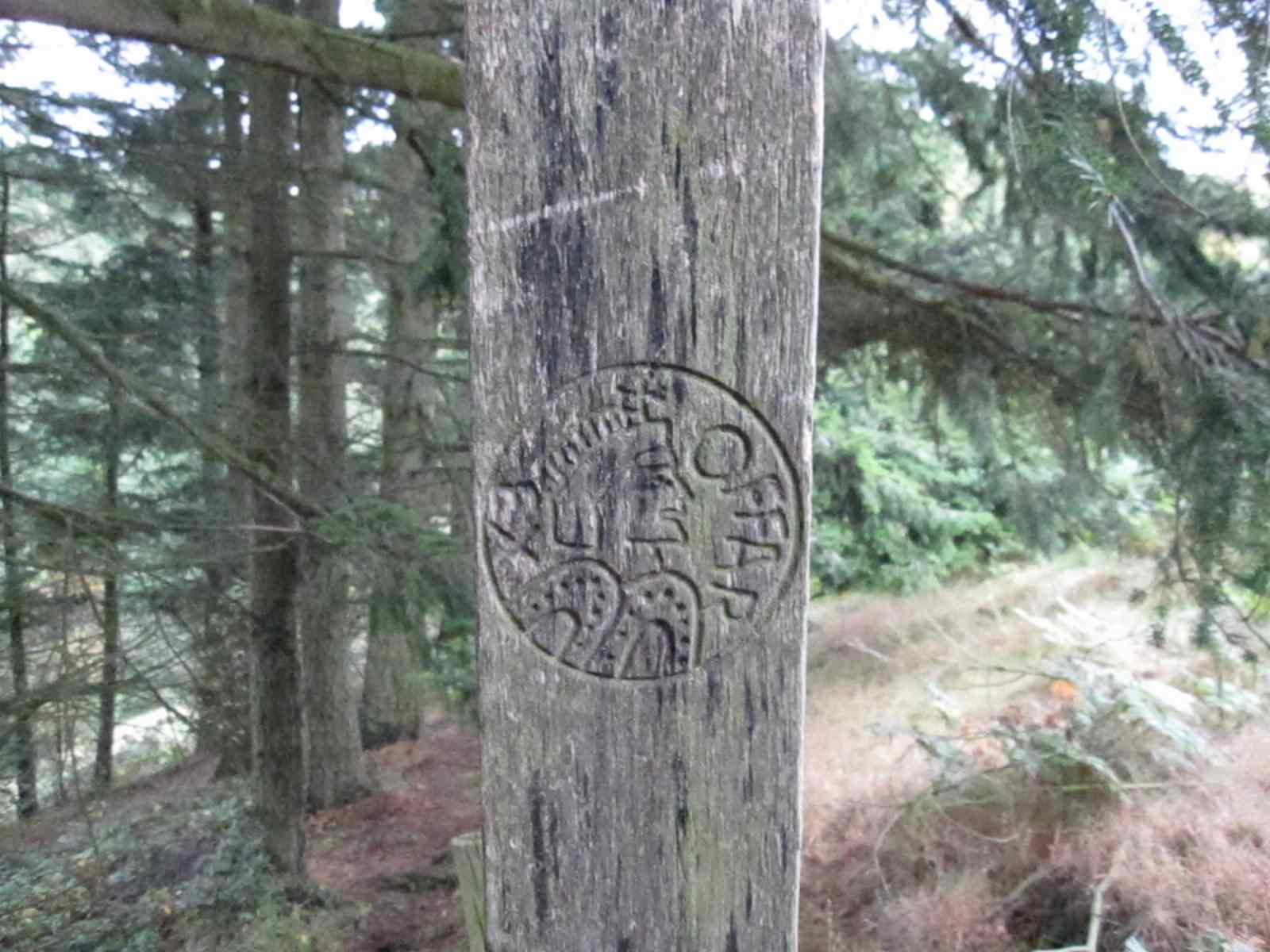
This part of the trail has some unexpected treats, over and above the return to the dyke. One surprise is a new symbol cropping up on some of the signs. This likeness of Offa is apparently taken from a Mercian coin.
And there are more rabbits, who seem to love to make their warrens in the dyke. However, unlike sheep and cattle, they are really hard to photograph, since thy bolt when I am still a long way off. So all I have are blurry super-zoomed images like this.
Even harder, of course, is photographing the big black birds (ravens, I think) that are simply everywhere, catching and riding the thermal air currents on the hillsides. So cool to watch, so hard to photograph whether it is a solo bird or a flock.
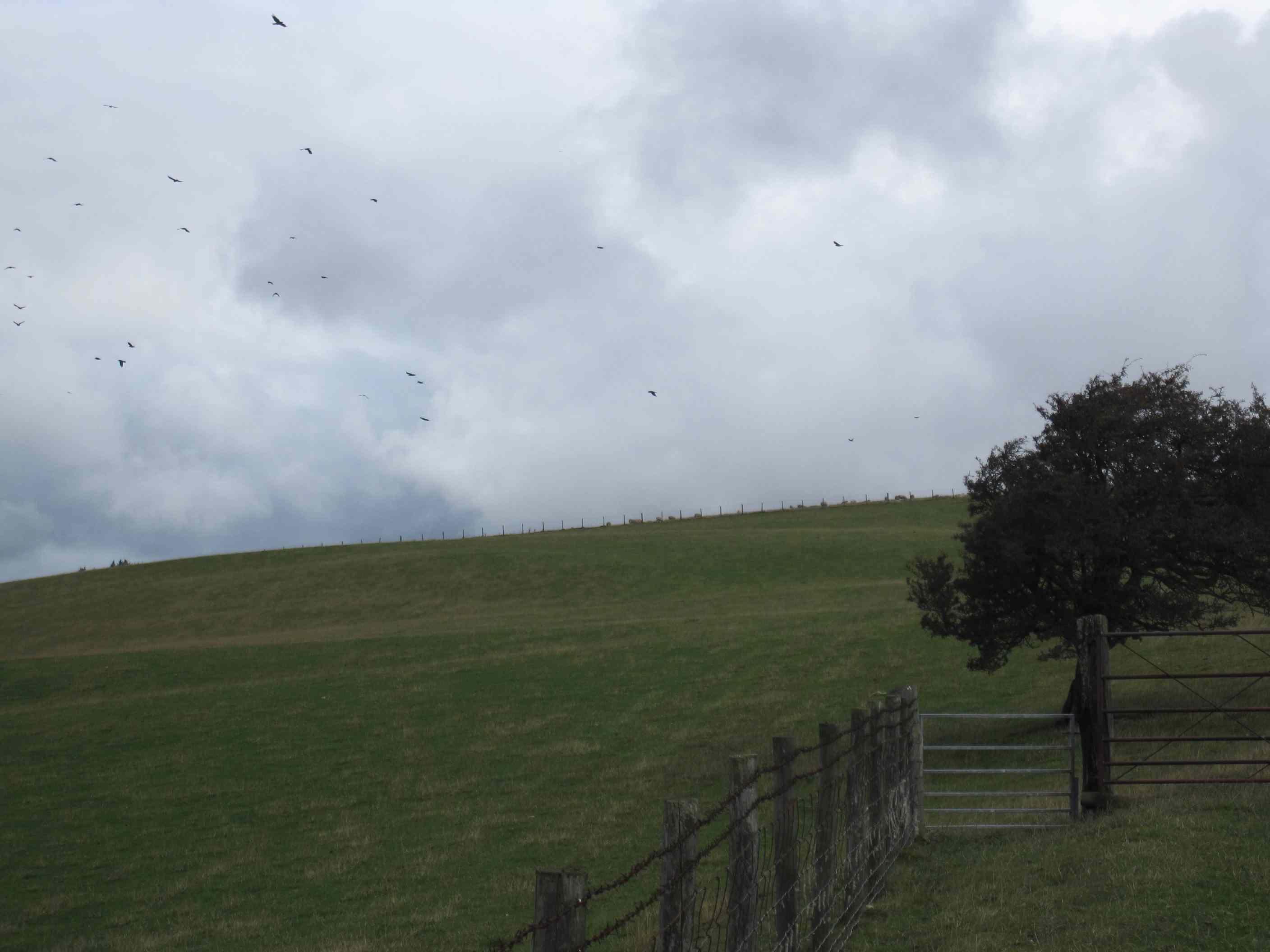
Yeah, not great shots, but just to give you an idea.
Oh, and during the morning, Sunday you’ll recall, as I came over a hilltop into a valley, I kept hearing what sounded to me like little snippets of amplified speech—a blast of a few words, then nothing for a few minutes, then more. The mystery was solved, partly, when I got to a better viewing angle and in the far distance could see this, some sort of event.

Herding dog trials? A car rally? A cattle sale? Beats me; I wasn’t headed in that direction, and damned if I was going to make a 2 mile diversion to find out.
And finally, I got back to the dyke, which set off a mad flurry of photography. Let it be noted that it is actually pretty difficult to get a compelling photograph of a long mound next to a long ditch.

But I tried. And who guards the dyke these days? You know as well as I do.

This should settle any complaints that I haven’t included enough sheep in my account! These fellows were encountered just as I had reacquired the dyke, and so I was pretty happy to photograph anything. Not that they don’t merit a photograph.
The rest of the walk to Knighton sticks pretty closely to the dyke. I did hit some rain, and in one stretch I was heard, by some sheep, to grumble “If the rest of the trip is all on-and-off rain I’m going to get pretty pissed.” But just when my mood started to flag, the sun would come out for a while, or I’d meet someone, like the two English brothers coming the other way (north to south), one of whom opened our conversation with “If I were one of Offa’s guards, I’d ask if you are English or Welsh.” To which I replied “Worse; I’m an American.” We had a good laugh over that. And so, after about 6 hours and 14.5 miles, I reached my rest stop, Knighton.
As small towns go, Knighton is somewhere between the fancy shops and books of Hay and the depressed crampedness of Kington. Knighton is a good place to stop for one special reason: the Offa’s Dyke Center is here. Which might not be worth more than 20 minutes of casual reading of exhibits about stuff I have mostly already learned. BUT the Center also has the route’s gift shop. I sense a T-shirt purchase in my near future.
Miles walked: 14.5
 ramblinghank
Hank,
I’ve been reading along also, with a little bit of walker’s envy. What a great trip, and so fun to read! You’re getting in shape, meeting interesting people, expanding your mind – maybe someday you could sell your stories to someone to offset the cost. That could be a pipe dream, but you’re a great writer!
The barn windows remind me of sniper’s slots in castle walls. Can you picture villagers racing towards the barn to the battle cry of “Defend the hay!”? Me neither. My real guess is that it’s cheaper and easier to build vertical slots between upright studs, that provide needed ventilation w/o needing a load-bearing header at the top. I don’t know if Dan is reading this blog, but we’ll alert him – he’d love reading it and might have a better idea.
From my cattle driving days (OK, my one summer job on a dairy farm…), I can pass along my trick for herding cows, in case you meet other bovine trail blockers. We used to throw softball sized rocks, to land on the ground right behind them, while yelling something like you did. If they had udders, they would generally move away from the rocks. I don’t know what would work for a bull, but I wouldn’t wave your guide book pages at him!
I hope you have a great time with the rest of your trip! Maybe you’ll bump into a shepherd who can teach you how to walk through the sheep without scaring the shit out of them (a natural part of the fight or flight response, as you correctly guessed)!
Tim
I like the idea that the slit windows are simply a structural solution to the problem of making strong headers over openings. That makes a lot of sense. I’ll bear in mind the rock-throwing herding trick, though there often aren’t many rocks and a lot of cowpies, which leads to a thoroughly disgusting alternative…
Hey Hank,
Loving reading your blog! Sounds like an amazing trip! I agree with you and my dad about the barn. Although as an architecture student I feel like I should make a comment about the tall narrow windows as emphasizing the ‘verticality’ of the structure..
Also, I can’t believe my dad made a pun about sheep shit. I’m not sure whether to be impressed or offended! He’s a rare breed..
Jokes aside, hope the rest of your hike is as good as it’s been sounding so far. I’ll be following along (not to sound creepy..)!
-Dan