Askrigg to Hawes, 6 miles, 410 feet of ascent
This was a mild day of walking, punctuated with one fun episode when I helped a farmer. Six miles with a third of the elevation of yesterday’s walk, although there were a few slick climbs up muddy paths, and in general a lot more mud from the light but frequently recurring rain of the last few days. So, before I get to me, I thought I’d say a bit more about Lady Anne Clifford, whose estates structure this walk.
I’ve been reading Richard Spence’s biography, which for the most part I find grindingly dull and bogged down in legal minutiae. And he is writing for an audience he assumes already knows Lady Anne’s life. He is, in short, a scholar writing in response to other scholars. A sample, from page 59 of his Lady Anne Clifford: Countess of Pembroke, Dorset and Montgomery (1590-1676) (even the title makes me drowsy):
So far in this study, Lady Anne has only intermittently appeared center-stage. The associates of her younger days, her parents, tutors, uncle, husband and King James, have been the main dramatis personae as the themes of inheritance, titles and estates, which came to dominate her life, have been considered. The spotlight now falls on Anne herself, as a countess, married for fifteen years to Richard, Earl of Dorset. So much is known from her Diaries about Anne’s relationship with Dorset that to dwell on the minutiae of the events and emotions they reveal would be needless repetition.
That’s page 59 of 250, when Anne first takes center-stage, and when he hand-waves away her relationship to her drunken wastrel first husband by saying it’s covered in her diaries. If I’d had a fireplace handy, I might have thrown the book into the fire. But once you get used to Spence’s fixations on lawsuits, you can start to glean what Anne was like. And she was fascinating.
Her reputation rests largely on her legal battles over her inheritance, but she is also remembered as ‘virtually a queen of the Dales,’ as my route guide puts it. She was the last of the line of Cliffords, and from what I have read she was clearly obsessed with the prior high status of her ancestors, and strove to regain lands they controlled and restore castles and other properties to their medieval glories.
She married twice. Her first husband, a drunken wastrel of a lord with a gambling habit that left Anne in deep debt. Her second marriage was strategic, to Philip Herbert, Earl of Pembroke and Montgomery, who was an influential figure in the royal court. That helped her with her debts and, more importantly to her one suspects, with her ongoing lawsuits against her uncle and cousins over the estates that she believed were rightfully hers because of the rules of the specific type of title she gained from her father’s line, even though that same father had left the properties (illegally, she thought) to his brother. Her second marriage was not especially happy, and for most of the next twenty years before Herbert’s death they lived apart. Since both of them had multiple estates, this was easily managed.
Okay, but what was she like? Well, she contained contradictions. She was sober and in her later life became famous for her piety and for her sober refusal to embrace the colorful fashions of the Restoration after Charles II was brought to power after the brief Civil War period of the 1650s. She wore simply cut gowns made from rough black serge, a kinf of uniform she adopted when all others were changing clothes with the season and wearing gold filigreed gowns with big ruffs and pearls stitched into them. One bit of snark from her time that gets quoted in every piece of writing about Anne’s style is this: “a dress not disliked by any yet imitated by none.” Snap! But in fact this was in her later years; she had been a lady of the court in her twenties, and dressed like it, as early portraits show. But she had spent years of struggling over money (she was freakin’ rich, but like the rich of all eras, her wealth wasn’t easily convertible and there were huge debts from her first husband and father, and legal bills from trying to regain her inheritance for 38 years). So she was frugal. She bought fabric and clothes from local makers in her own lands, which was good for the economy of her estates and her local reputation, but also cheaper than the typical habit of the titled of buying clothes from London clothiers.
And though she was frugal, she took the role as a titled person seriously. She worked to improve the lands and fortunes of the people who lived on her lands, and she spent where it mattered. Here’s Spence on Lady Anne in the last decades of her life (she lived to be 86, but kept moving from estate to estate, visiting multiple properties every year):
Her household removes were renowned ceremonial occasions, in which local gentry and other people often attended her in a great train, almost like a royal progress. The practical side was the hiring of carts to transport the bulky furniture, hangings, linen and kitchen utensils. It took forty-eight double carts at 2s 6d each to carry her goods from Appleby to Brough in September 1675. At every remove there was munificence. When, for example, she left Appleby for Pendragon on 24 March 1674 she gave 5s to the prisoners in the Appleby goal, the same to the poor, and to the ringers and waits who gave her a musical send-off. The poor on the way got 7s, those at Pendragon Castle 2s 6d, two men who helped with the trunks 4s and two men who walked beside her litter 10s; no small boost in their incomes.
So, dressed soberly and cheaply, but spent a fortune on gifts to her friends, family (the ones she wasn’t suing, and in fact some of the ones she was suing, with some of whom she maintained cordial relations), and the people on her estates. Pious and serious, but also a bit self-aggrandizing, making sure that any time she restored a building or improved a property or built a monument to someone (her father, a few poets she liked, including John Donne), she had a plaque made noting she did this. (Even the door latches she had forged, which she gave out across her lands to churches and some small holders with houses, had her initials on them.)
Okay enough about Anne for a while. Later in the walk I’ll visit a few of her most famous old castles, now ruins, that she restored in her quest to raise herself to the glories of her ancestors.
As for me, I had a light day of walking that started with making my way out of Askrigg. Along the street, I found the local funky bohemian artist type’s house:
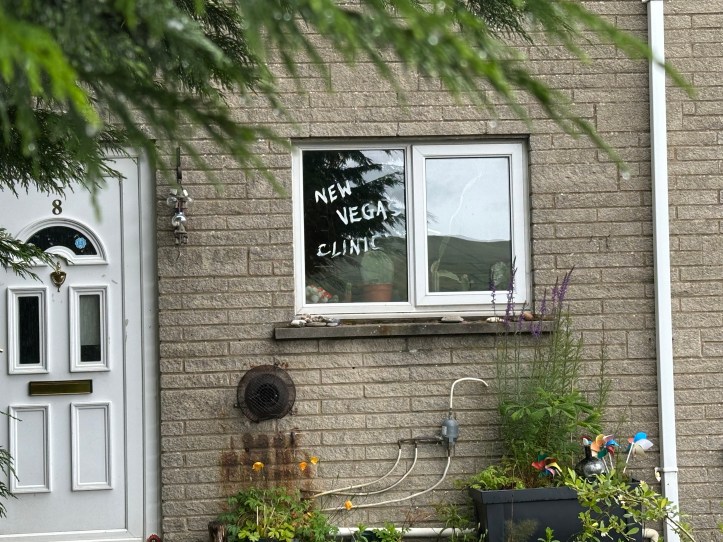
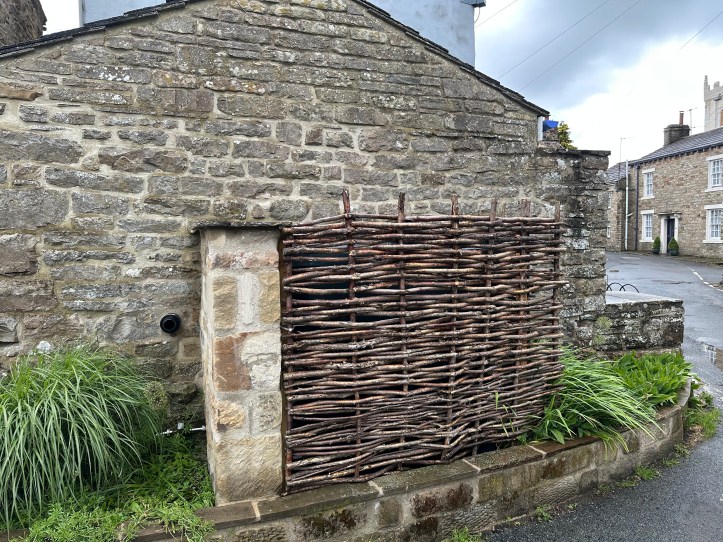
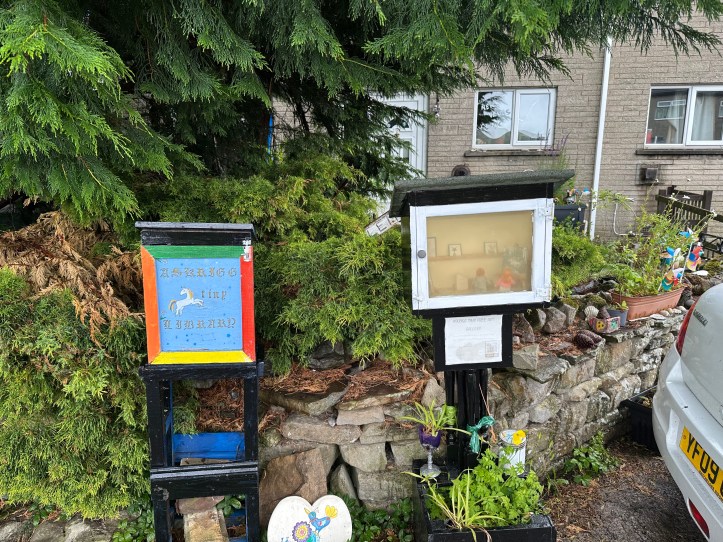
From here, the path climbed gently but muddily through fields and then into woods above a stream.
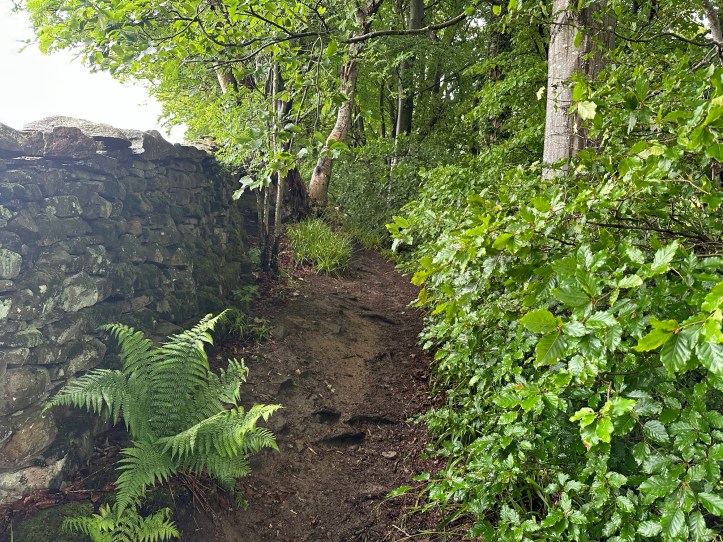
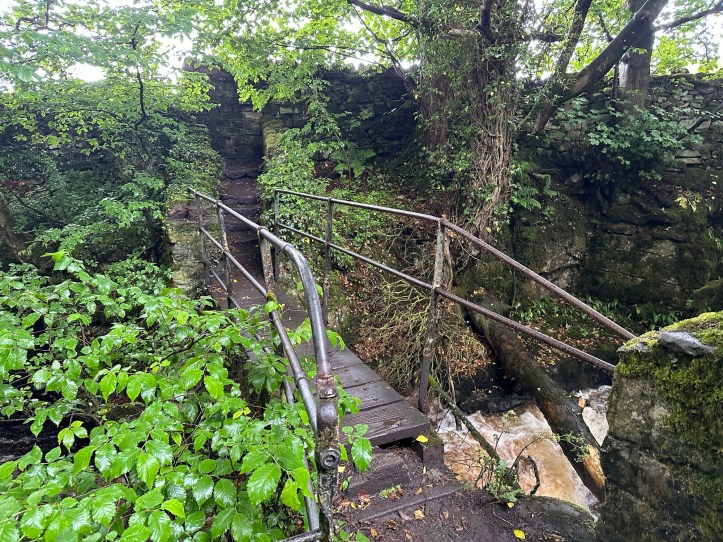
After a short while, the path broke free of the woods and for several miles I was crossing fields and then on a rocky dirt lane passing by farms.

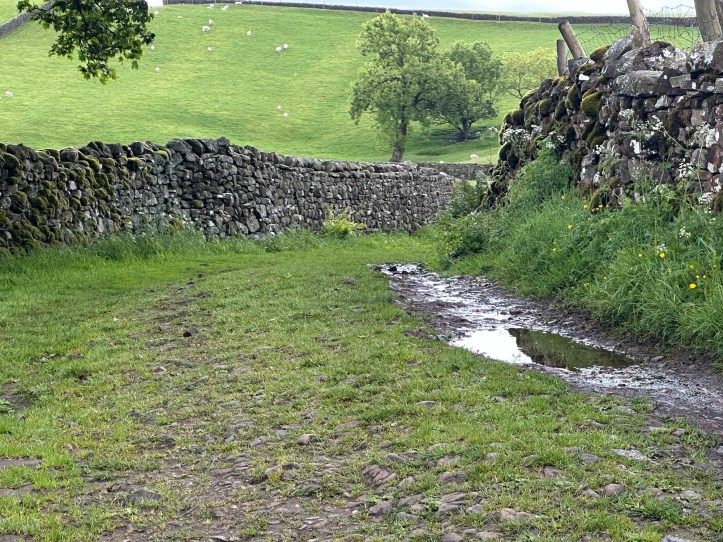


I was walking down an unpaved road between two stone walls when I saw a jeep with a trailer coming up the lane toward me. About fifty yards off, the driver pulled to one side, got out and opened a gate in the wall behind the trailer. It couldn’t quite swing all the way ope because his trailer was in the way, so he got back in and pulled the jeep forward a bit. I was of course still walking toward him, and when he got out again, I was just reaching him. “Do you need a hand?” I asked, not really sure if he was going to try to back that trailer into the field (seemed impossible given the narrow lane) or what. After the briefest hesitation, he said “Yeah, thanks. If you can go stand there behind the trailer in the middle of the lane, I’ll get the cows out into the field.” Yes, he had six cows in the trailer, and he was bringing them up to pasture for the first time all season. So the cows were excited, and my standing in the lane was just one more thing to encourage them to go through the open gate into the field. Now, I’d had my little adventure with cows a few days ago, but I figured the farmer knew what he was doing, so I stood, trying to look big and like an obstacle to cows thinking they might skip the field and just run down the lane. He let the cows out, and with barely a look at me they practically scampered into the field.

“They’re a bit frisky because they’ve been cooped up all winter. They’ll run it off in a while,” he explained in a thick Yorkshire accent. Then we chatted about pasturing cows and the dry spring and the paradox that so much dry weather meant farmers like him could get a lot of things done, but then they noticed the grass wasn’t coming in green in May when expected. I tried not to ask dumb questions, but to just listen and nod and ask simple things like “Is this later than usual to put them to pasture?” and “When do you bring them in for the winter?” and “Are your cows part of a cow gang that threatens walkers?”
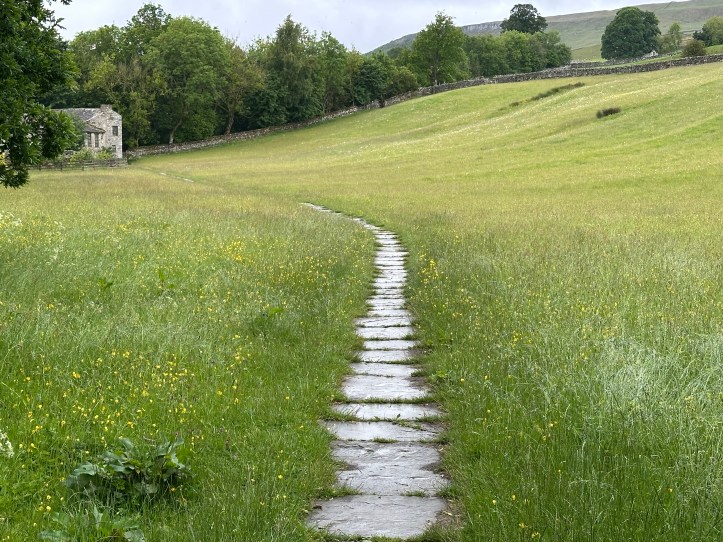
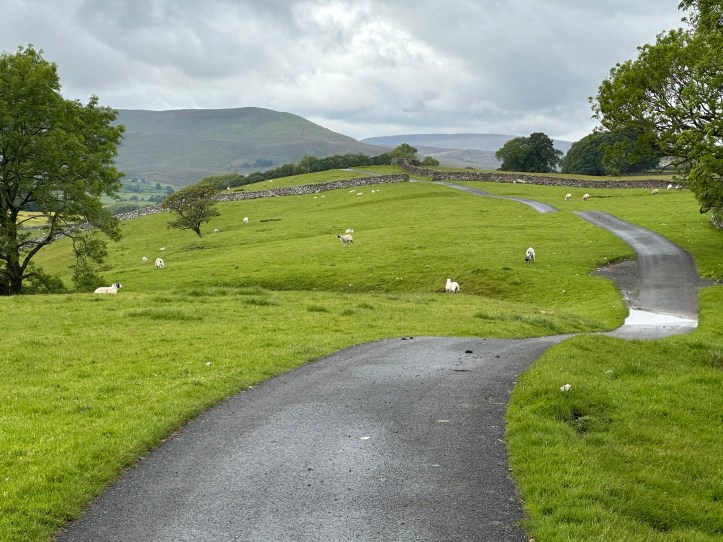
From here, feeling very pleased with myself, the rest of the walk was an easy amble across more fields and down across the valley to get to Hawes.


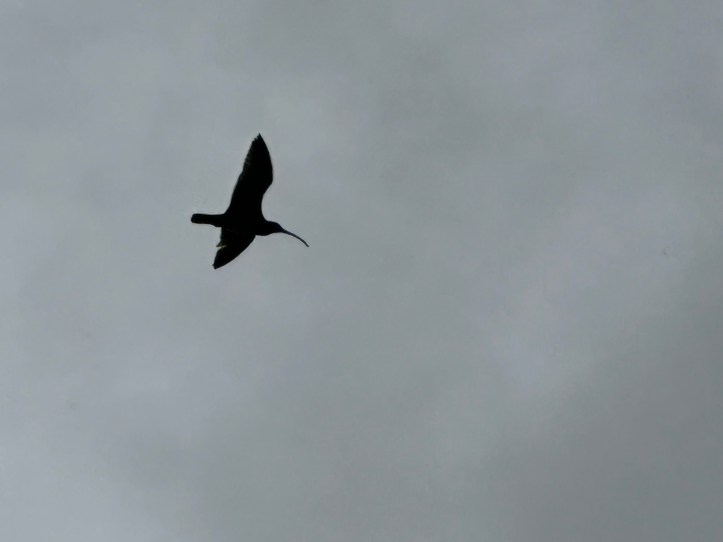
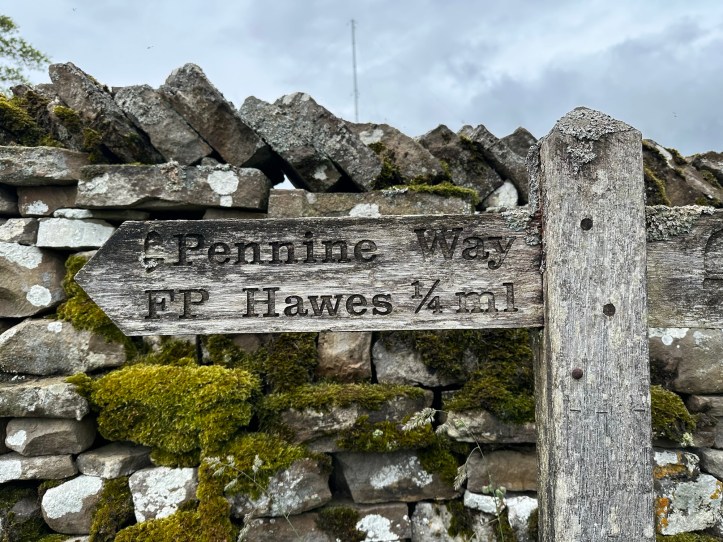
I had time to kill (again, B&B keepers with a strict 4pm opening time, so I wandered around this small town and treated myself to two scoops of ice cream (banana and blackberry crisp, which had bits of crumbly streusel in it).
Slight mishap on arrival. I plugged in my laptop to charge, but put it on a chair not paying much attention. It fell off, and broke the attachment point of the USB to USB-C charger cord. Fine, I thought, I carry extras of all my electronics charging kit. Uh oh. In my packing rush, I packed two spare USB to Apple Lightning charging cords (phone is old , uses lightning connector) instead of the intended one for USB to lightning and one for USB to USB-C.
So, laptop was at 45% charge, and I am in a small, small town today, and might not find a store with charging cables until Penrith or even London. Solution? I also brought a battery cell, so I have charged my laptop up to 70% and will use it only for posting, using my phone to do as many preliminaries in WordPress as possible. Fingers crossed I stumble on the right charging cable in one of the next few towns.
 ramblinghank