Appletreewick to Grassington, 6 miles, 761 feet of ascent
Now, I know what you’re thinking. You read about me walking along the Wharfe yesterday, retracing my footsteps from Day 6. If I’m going to Grassington, it’s just going to be me finishing out Day 6 and doing the first, easier bit of Day 7. Ah, but that was on the Dales Way. And I am now on Lady Anne’s Way, and Lady Anne was famous for her determination to do things her own way. So today’s route does indeed repeat the first stretch along the river to Burnsall, all very nice and straightforward. But then the way veers off away from the river to take the higher path to Grassington.

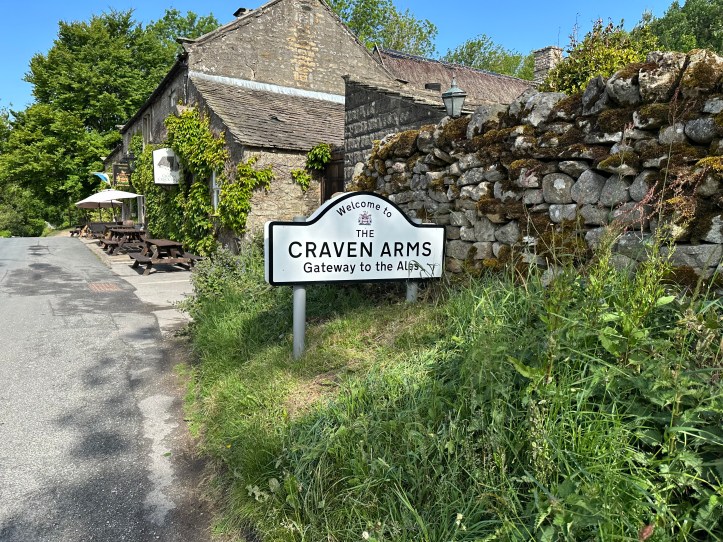

The skies were a bit grayer than I’d like, and there was a pretty steady breeze that made the low 50s temperature feel a bit brisk. Hence my fleece to start the day. I walked back down the hill to the campsite by the river, where I had left the path at the end of yesterday’s walk. And from there it was easy, cool walking to Burnsall.

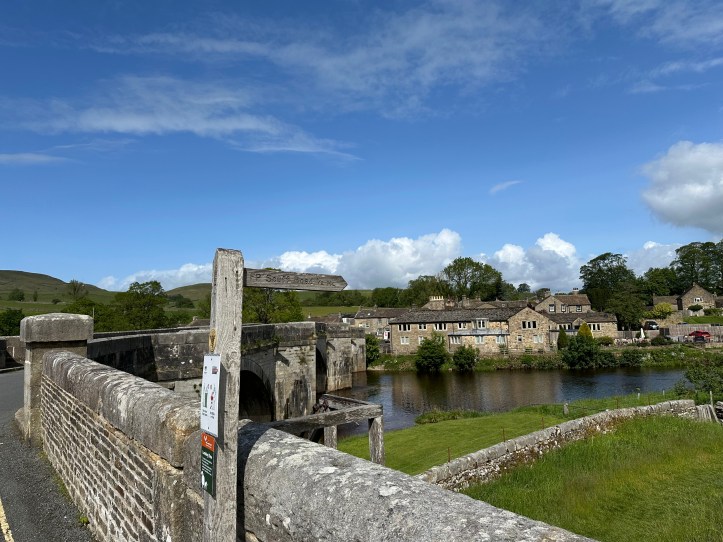
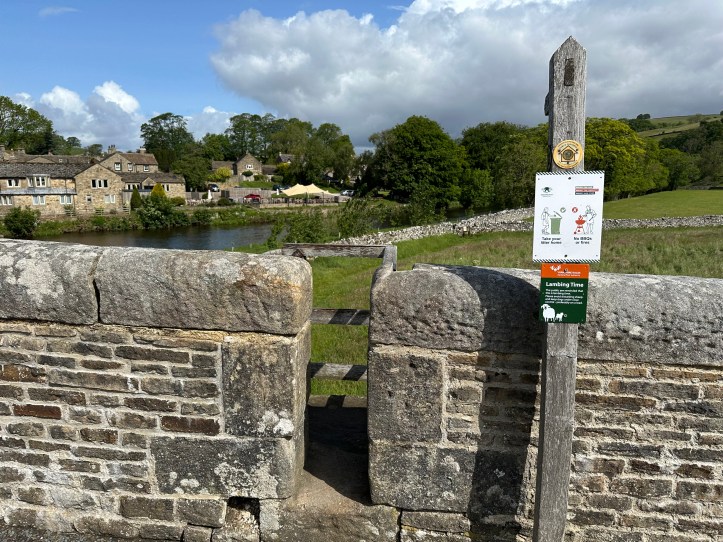
But my new bovine nemeses had a few tricks up their sleeves.
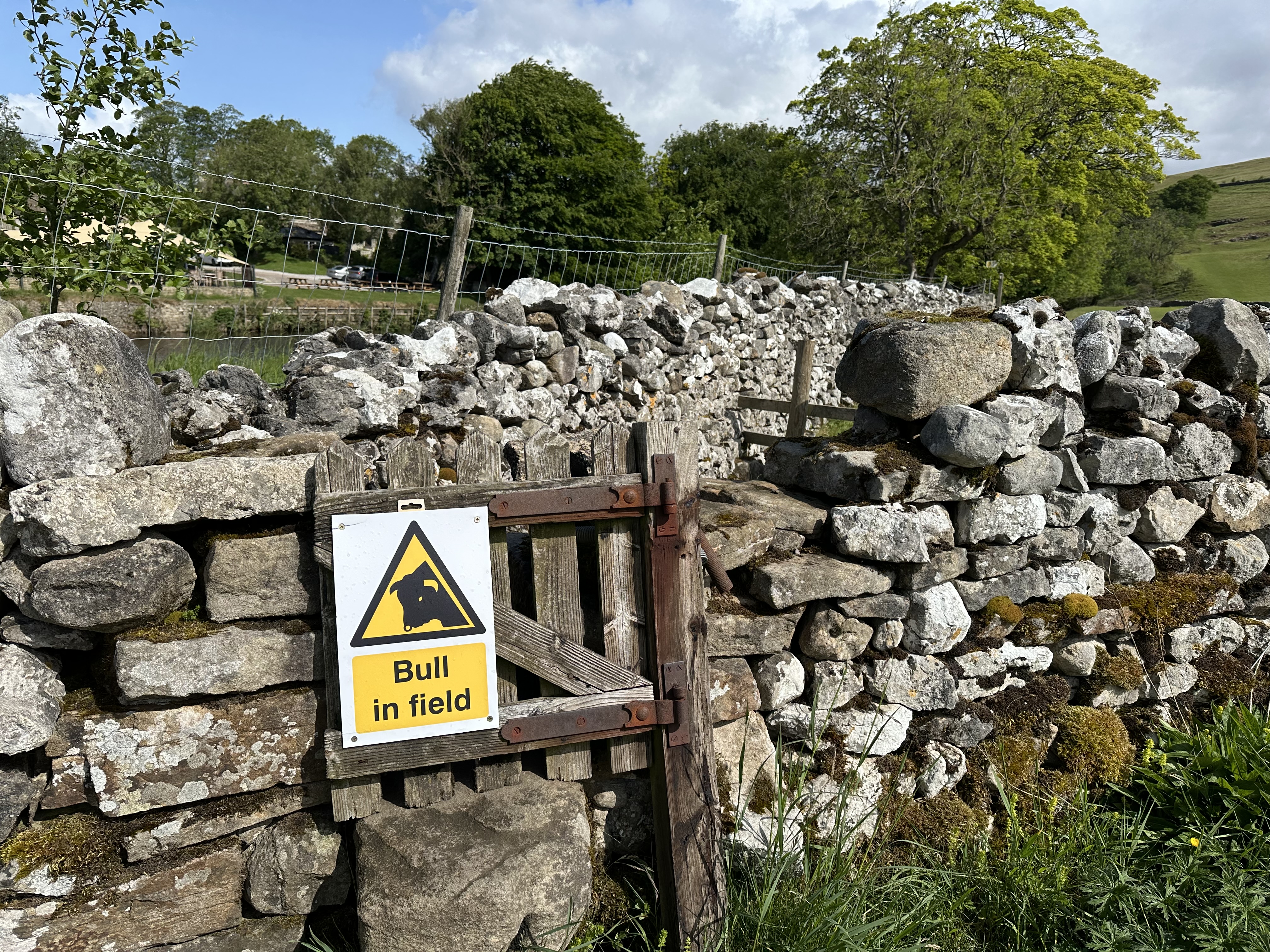
The sign is a good proper trail warning to proceed with caution. So I scanned the next field. No sign of a bull or any cows at all. As I got the the other end, I am pretty sure I heard the distinctive sound of cows chuckling.
And then the big climb. My guidebook notes that the way tries to follow paths Lady Anne would have taken in her carriage (a rural carriage, so probably pretty rugged), but sometimes it’s clear we aren’t exactly on a path a carriage could navigate. Those stone walls with stiles are mostly later additions, but there are other things, like this first ascent, that no carriage could do. It was a serious 45 degree climb to get up, and, like many uphills, it teases you by letting you see something that looks like the top until you get there, only to discover that was just phase one.
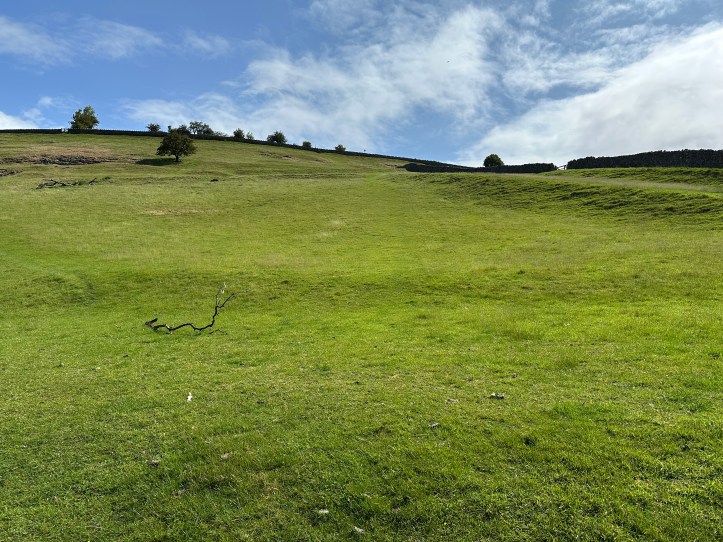

When I made it to the trees you see in the slideshow above, there was a little narrow road, and then more hill.

The path wasn’t always clearly tamped down, but usually I could see ahead to a wall with a stile and a marker post, so it was easy going.
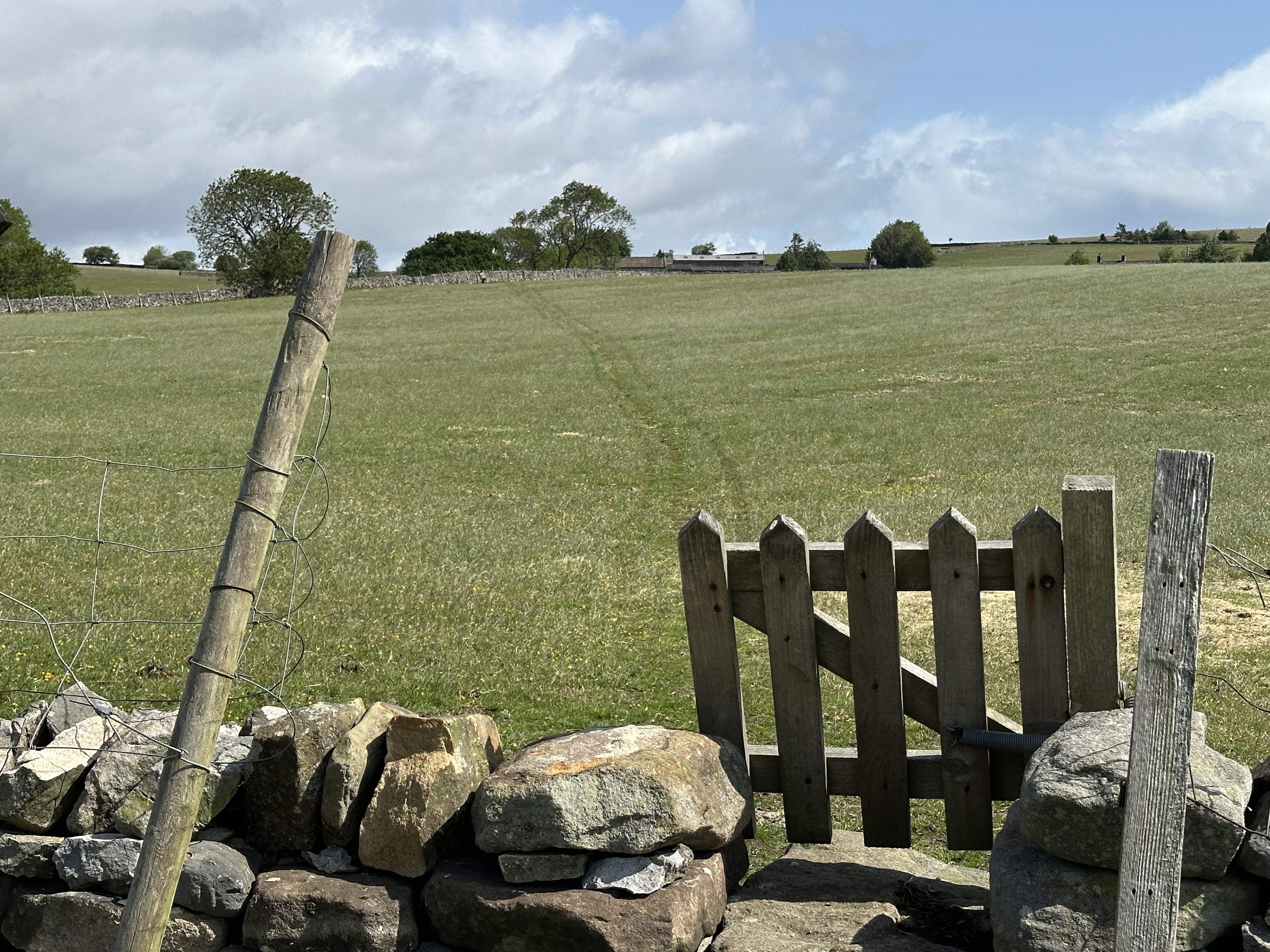
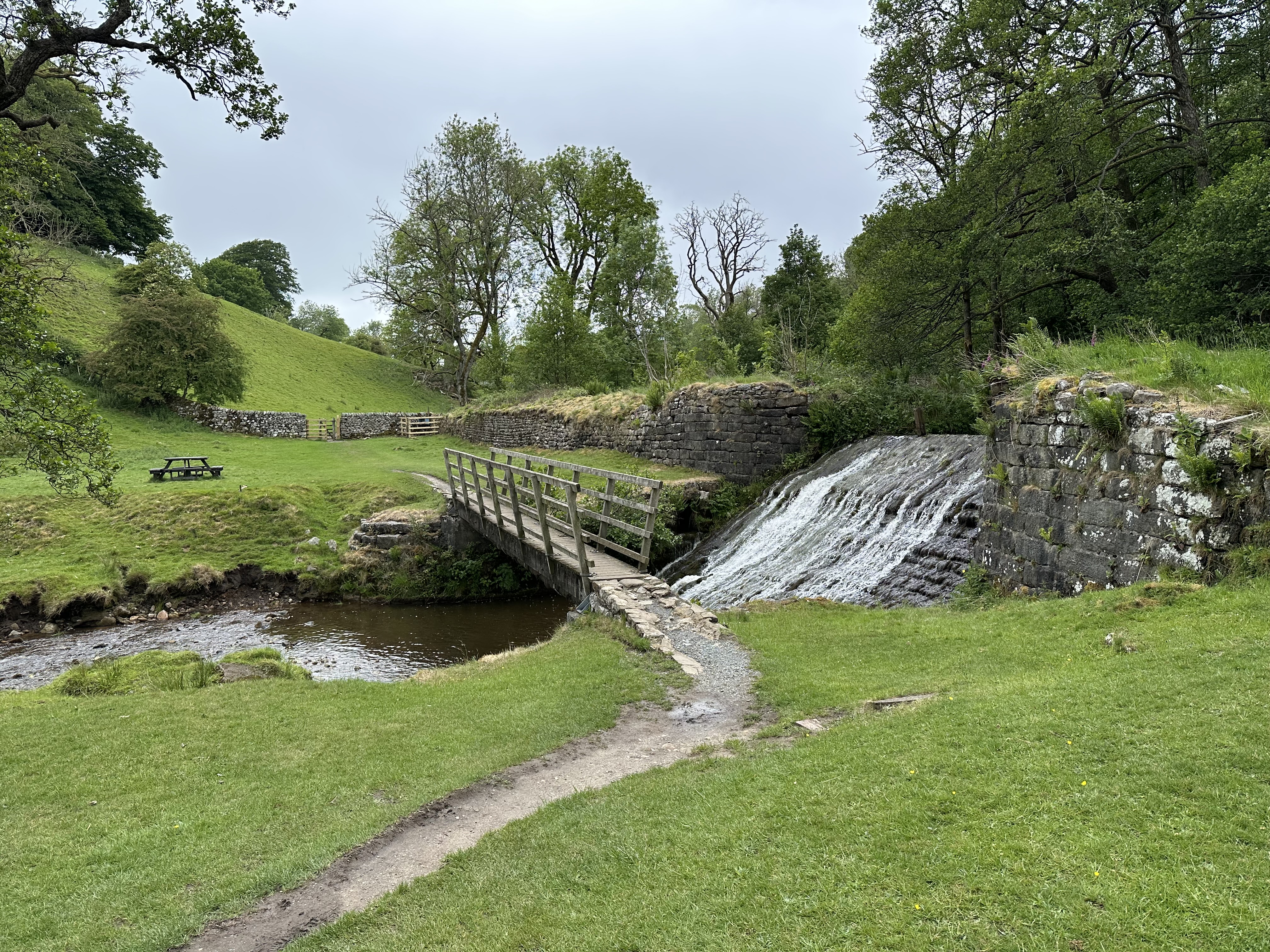
Soon I was over the top of this minor ridge and crossed down into Hebden, a pleasant little village. All this time, the wind was pretty steady, so I stayed in my fleece. There were a few minutes of misty light rain, but on the whole it was a good walking day. Hebden offered a nice little surprise in this man-made waterfall where the river has clearly been redirected.
In Hebden I encountered a regular trail phenomenon, the conflicting, impossible mileage claims of signage. I passed a sign saying it was 2.25 miles back to Burnsall. Seemed a bit high. Then a sign pointing ahead indicated 2 miles to Grassington. Okay, but my guidebook claims that Burnsall to Grassington is 3.7 miles. You do the math.
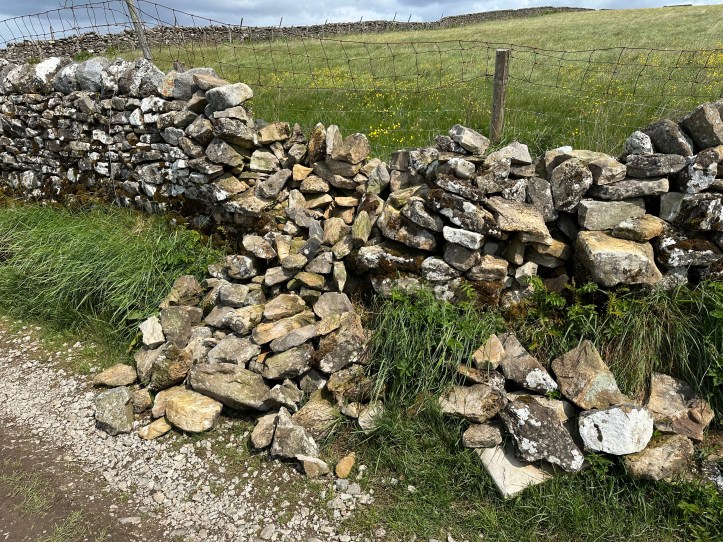
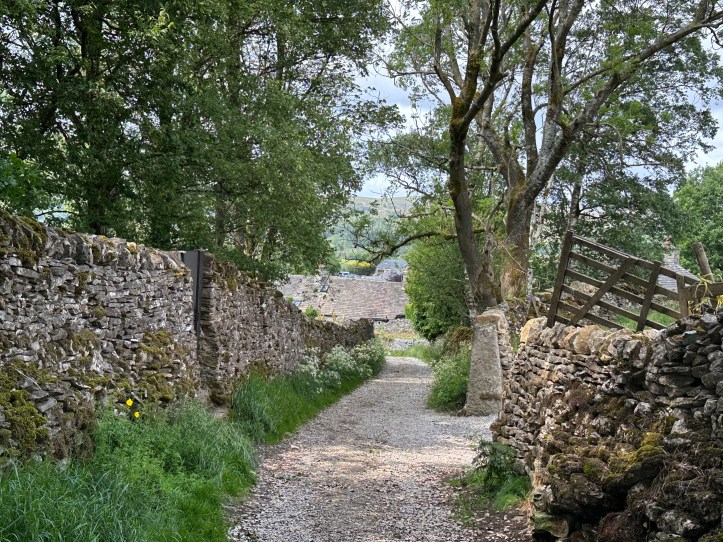
Anyway, from here the path went through some fields to reach something called the High Lane, an unpaved lane that I could actually imagine a carriage making a VERY bumpy ride along as Lady Anne made her way, as she often did in the second half of her life, from one residence to another on her vast estates. First a few photos, then a bit about Lady Anne.


So, first in a series of fun facts and biographical bits about Lady Anne Clifford (1590-1676). Lady Anne is perhaps most famous for protracted legal battles she waged over inheritance. She was an only daughter, so when her father died, she became by default the Baroness de Clifford. But her father’s earldom passed to her uncle, her father’s younger brother, and with the earldom her father bequeathed his estates. Anne was, shall we say, not amused, and she entered into a legal war to get the estates she believed were rightly hers as part of her inheritance of the title.
This legal battle involves complex points of English law: She pointed out that in the 1300s, King Edward had granted the estates to the Cliffords under absolute cognatic primogeniture, which means the firstborn child inherits the estates of the parents. Anne felt that her father’s will, leaving the estates to his brother, was therefore invalid. The fight for her estates would take decades, but Anne Clifford was patient and persistent and had, from the accounts I have read, an absolute conviction in her beliefs. She was one tough broad.
And eventually, she got the estates back, partly by legal victory and partly by cousins dying without heirs and a lot of other complicated wheeling and dealing. It seems, frankly, like she just wore everyone down until she got what she wanted. And she outlasted a lot of her family foes, living to 86.
And as she regained various bits of the properties, she become a terrific force, restoring castles and building almshouses and whatnot. She has a reputation, well-earned, for marking everything she did, so peppered across Yorkshire and Cumbria you will find stone tablets and other markings that proclaim something along these lines: “This building was restored to its former glory by Lady Anne Clifford in the Year of Our Lord 1663, to the greater glory of God.”
Some commentators take a rather wry tone and suggest that her own glory was also involved, but the more I learn about her, the more I am on her side. For instance, she was a dedicated believer in buying local, so she made a point in all her refurbishing of her many estates to use local craftsmen, buying locally made cloth for her dresses, and hiring a local painter to make multiple copies of a portrait of her that she liked. She gave these to various and sundry family as gifts. (Okay, that’s pretty self-aggrandizing, but she used a Yorkshire painter instead of using an artist in London, which most nobles of the time would have done because London connoted status. She was a big promoter of Yorkshire and Cumbrian products.
So if she’d had pillows in that carriage making its jolt-y way over the hills between estates, they’d have been locally made.
Anyway, I made it to Grassington around 12:30, with a ton of time to kill before my room would be available at 3pm, so I sat in the town square for a while, watching the mostly senior tourists wandering into and out of the bakery, the other bakery, the ice cream shop, the outdoor clothing store, the gift shop, the curio shop, the tea room, the other tea room and the coffee shop. Yup, Grassington is a pretty touristy little village. And at the bus stop right on the central square there was a note saying that on June 2nd and 3rd, there would be no bus service at this stop due to filming for All Creatures Great and Small.

All in all, a good day, and the cows seem content to merely taunt me a bit and let me go.
 ramblinghank
Fantastic set of photographs. I have done this one many times, such a beautiful walk too 🙂
I want a “Bull in Field” sign for the background of Zoom meetings.