One of the secrets of long walks is that the day after a super-long day can be when you pay for it in aches and pains. Today was a good 12-mile walk, at the upper mid range of distances, but I was tired from the big 16.5 yesterday (did I mention I walked 16.5 yesterday?), and I developed blisters on the sides and backs of my heels. This morning I did some fancy moleskin work trying to protect those blisters (you don’t want to put moleskin on the blister; you want to create a frame around it that keeps it from rubbing against the boot). Even so, this was a day I felt in my heels.
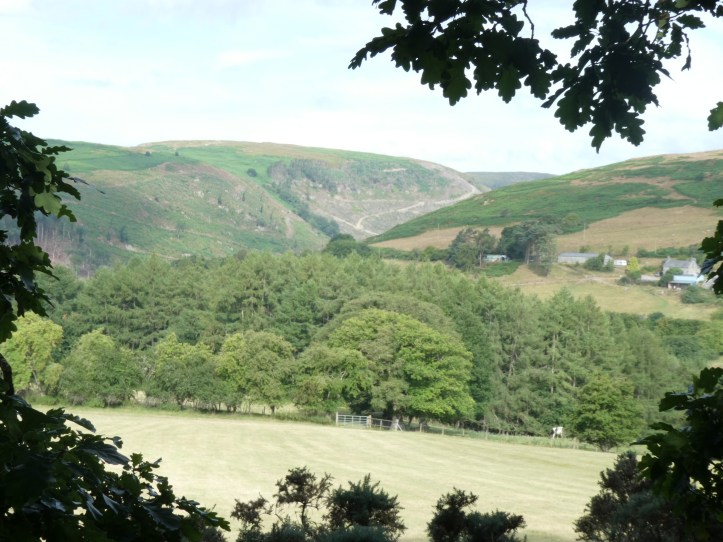
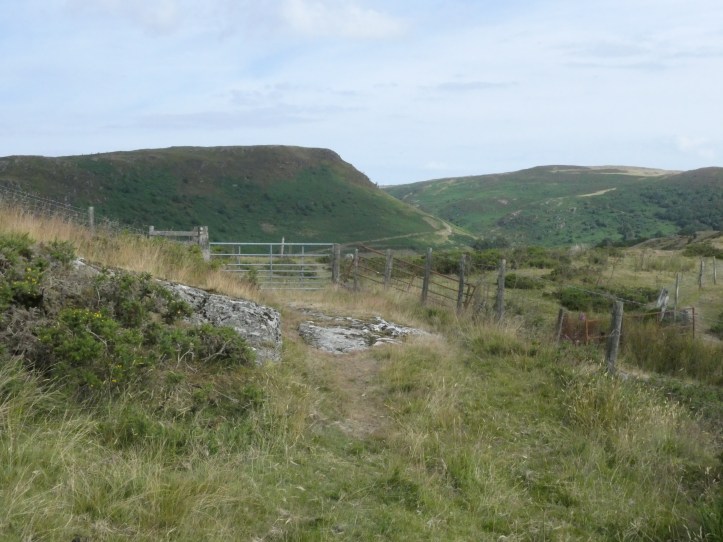
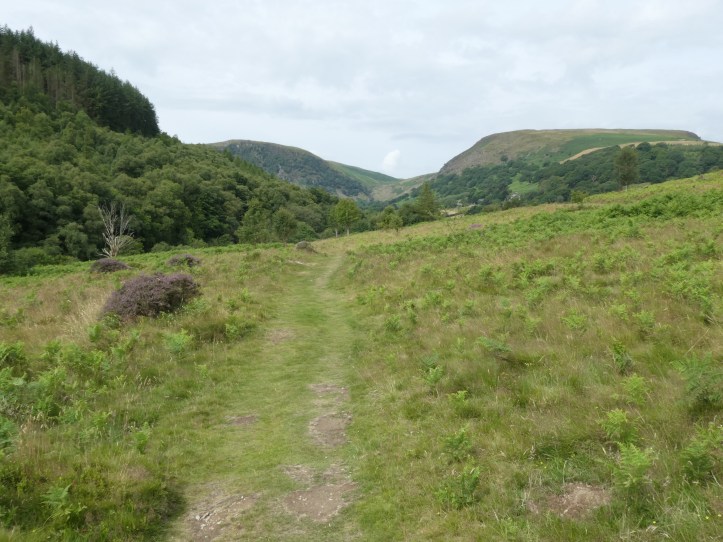
But the walk from Rhayadar to Llangurig is one of terrific views of the changing landscape. In mid-Wales, and I’ve mentioned, you can see rock exposed in the hills, so different from the smaller and totally plant-covered hills of southern Wales. There’s a sort of drama of scale that makes me take out the camera a lot and capture photos that never quite convey the wonders I see.
Before I continue, a brief sidenote. Yesterday I described the move of putting something back in the top pocket of my backpack, something I can do without taking off the pack. Just to help you visualize that, here’s the top of my pack
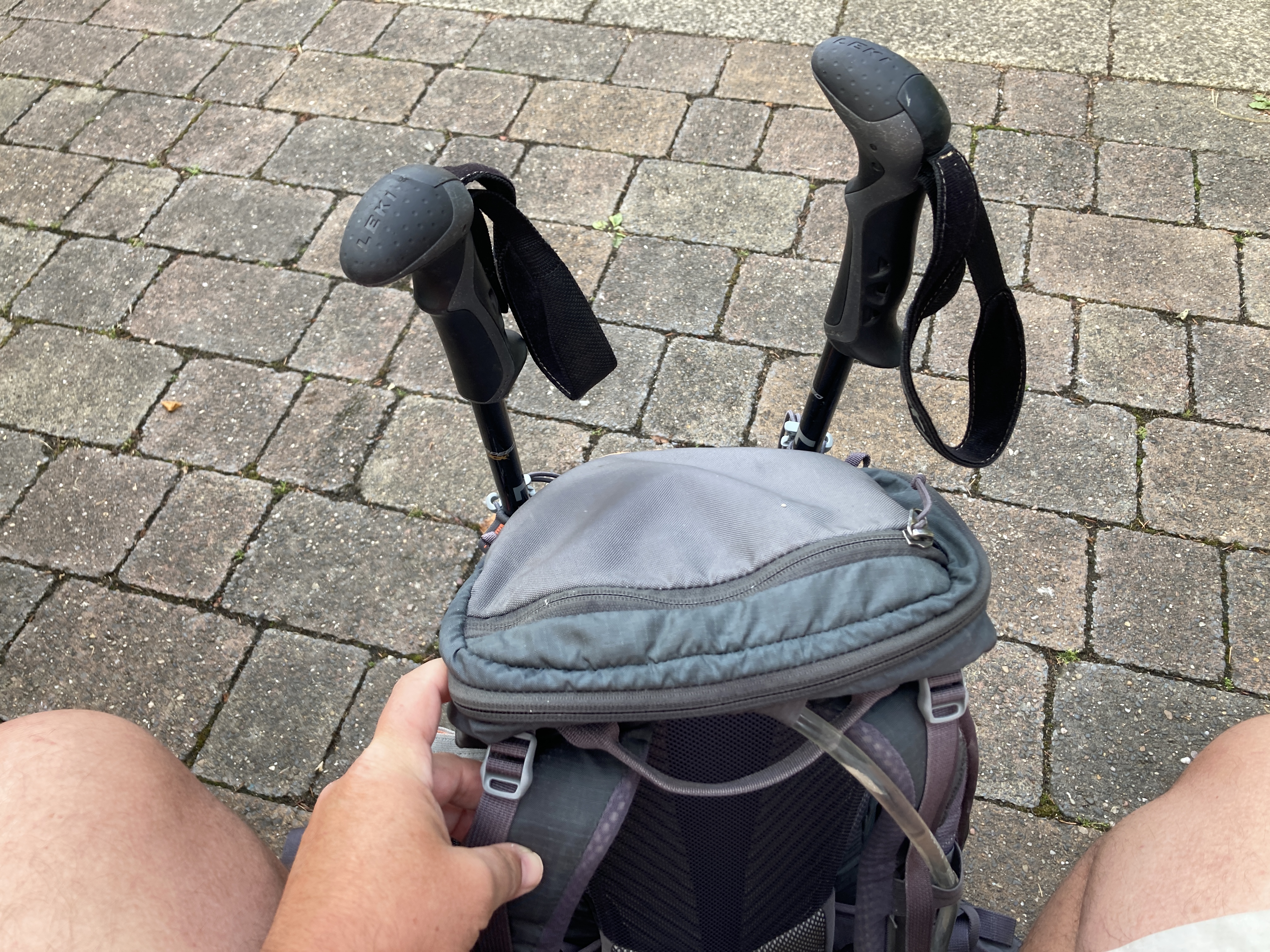
Try not to be distracted by the peekaboo shot of my very fetching knees. Those are the shoulder straps, and at this moment in the morning, as I sit on a bench in a little roadside park in Rhayadar, I have my walking poles strapped to the back. The plastic tube is my water supply line. So if I need something from that top pocket (phone, glasses case to change from sunglasses to regular, next set of guidebook pages, little plastic baggy of coins for a quick purchase of Diet Coke or a candy bar on the rare occasions when I am in a town with a shop), I reach behind my head, unzip, grope around by feel, and get what I want. It saves me taking off my pack perhaps a dozen times a day. And, let’s be honest, it gives me that little charge of feeling so accomplished at the little bits that come from doing a lot of walking. Yeah, I’m a guy who can walk and get something from behind my head by sense of touch, thank you very much.
Rhayadar is, I am sure, a perfectly fine little town, but the WiFi in my inn was atrocious, and it took an inordinate amount of time just to upload my photos to WordPress. That may seem like a little thing, but it was enough to make me happy as I climbed the hill on a small road out of town. And then climbed some more. Then the road turned and went uphill for a while until, plot twist, it went uphill some more. The hills hereabouts are just really huge, and you can’t see them fully until you are at the top on open ground, so sometimes the ascents can be a series of little heartbreaks: not at the top yet?
But when you get up into the high pastures, as I did after the path turned off this paved road (finally!), you get amazing views, and often there are hawks. I am comically inept, as noted before, at photographing hawks in flight. Partly it is because I am nearsighted, and so there is a tricky back and forth of: glasses on to see where in the sky the hawk is, aim camera in that general direction, glasses up onto forehead to look into viewfinder, move camera to try to get hawk in the shot, zoom in to get a good shot, lose hawk because it is, you know, flying around and so doesn’t stay still, sweep camera across sky, regain hawk and try to take a picture. Here’s the resulting series of photos with no editing.
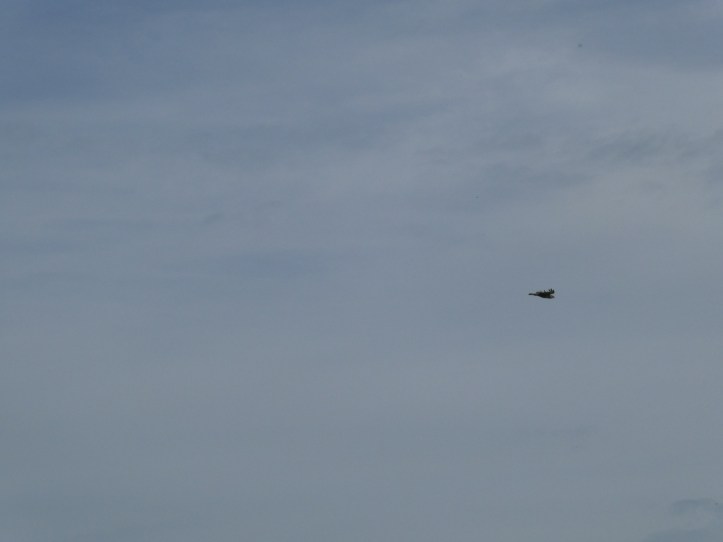
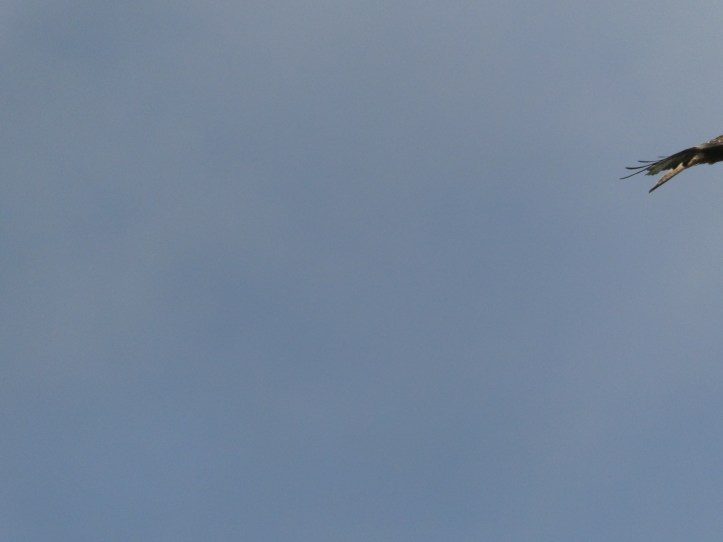
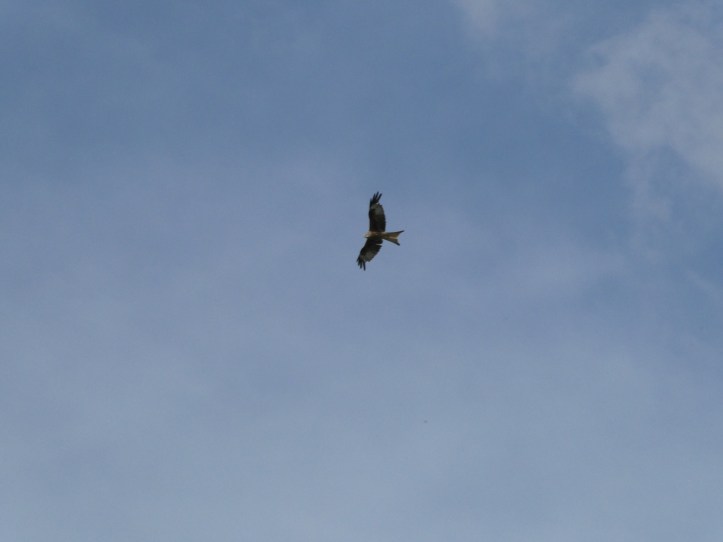
And here’s the unimpressed reaction from a cow in the field.
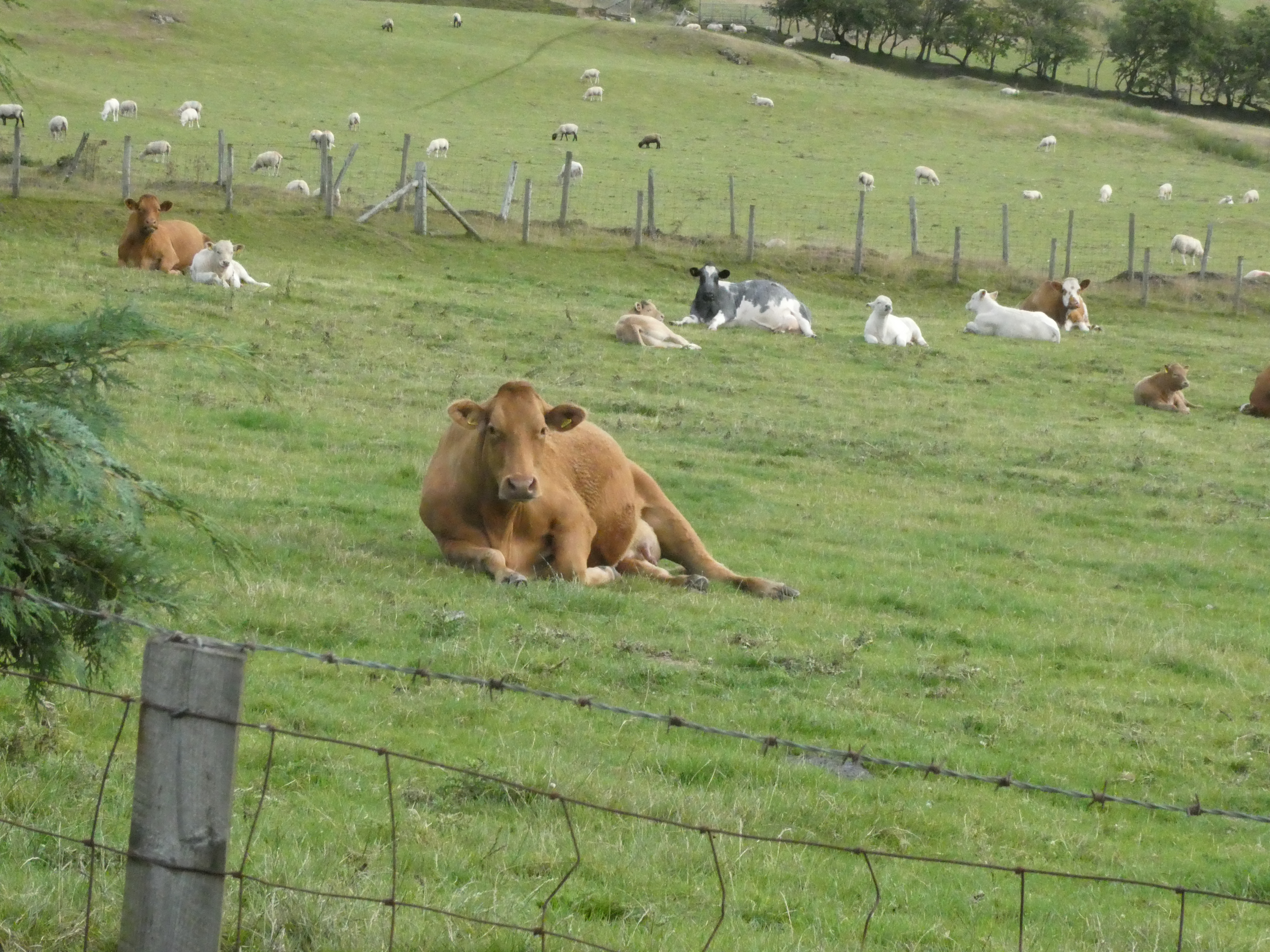
That cow has seen things.
One thing I haven’t talked about much on this trip is the infinite variation when it comes to gates and stiles. Even longtime readers will not remember, because why would you remember this from eleven years ago, but I became obsessed with gates and stiles and documented a lot of varieties- metal kissing gates, wooden kissing gates, stiles built into a rock wall with rocks sticking out as the steps, wooden stiles in a state of epic decay, gate latches with tall handles for horses, tricky compound lock latches (in case the sheep developed opposable thumbs but not bigger brains?), etc.
Here’s one I’ve seen a lot of in the last few days. There’s a loose metal piece to keep you from drawing out the bolt, so you have to flip it up to pull out the bolt. Again, does the farmer think the sheep and cows are going to figure out a way to draw the bolt?
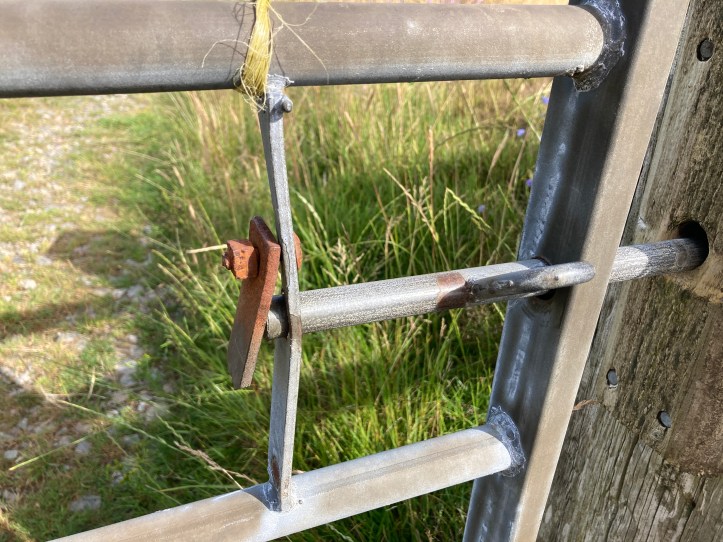
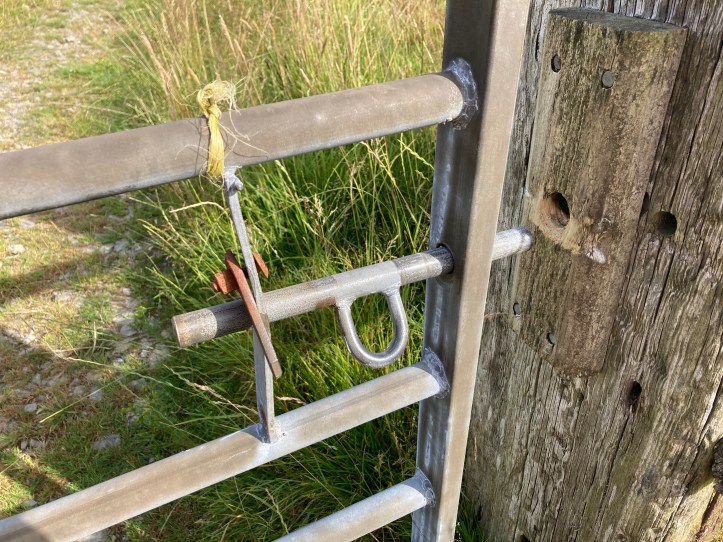
Just imagine that moment when an ambitious flock of sheep, tired of grazing in this field and ready to see the world, have somehow used their tongues to flip that cover, done some fancy back-kick to move the handle into the sideways position so the notch in the bolt passes through the hole, gripped it in their teeth to pull the bolt free of the gatepost hole, and pushed open the gate. “Well, Charlie, what do we do now?” asks one sheep of another. “Well,” Charlie replies, “there’s some grass over there.”
For the purposes of further allowing you to laugh at me, I will now confess that I entertained myself on today’s walk by singing to sheep in the fields, deploying songs with ovine puns. Imagine me warbling out in my best Sam Cooke imitation, “Darling, ewes send me, I know ewes send me, honest ewes do, honest ewes do…” The sheep, I must note, are weirdly entranced by this, and do not respond with their usual move of shitting and running away. They just sort of stare.
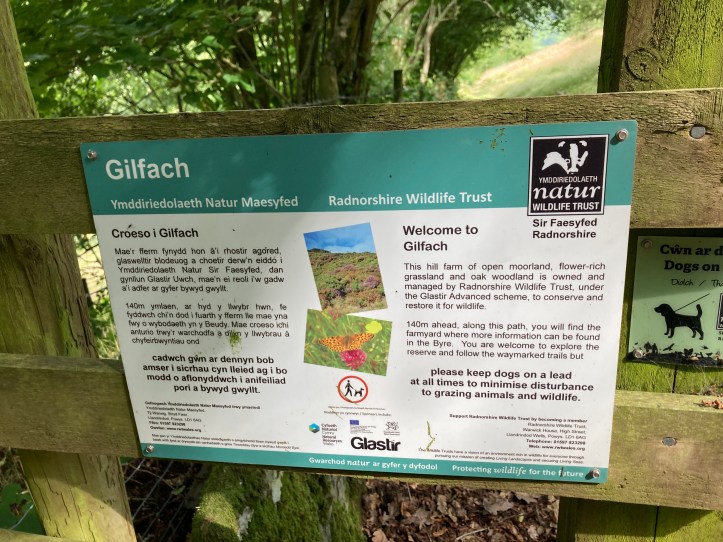
The path passed down from the high country (temporarily, of course), into a small twisty valley where, for a brief bit of disorientation, the path follows a stream downstream. Of course, at this point we are far from the Wye, and this is just a tributary making it’s way to the Wye, but after walking upstream for ten days it does throw me a bit. In this valley is a lovely nature reserve with a preserved Welsh longhouse (a style of architecture built into hillside by cutting into the hill and pushing the dirt and rock out and down into a pile and then building on the somewhat flat surface, with a long single building to house people and animals). My photo of the longhouse was hastily taken, blurry and not worth sharing, but here’s some signage and a nifty old bit of farm equipment.
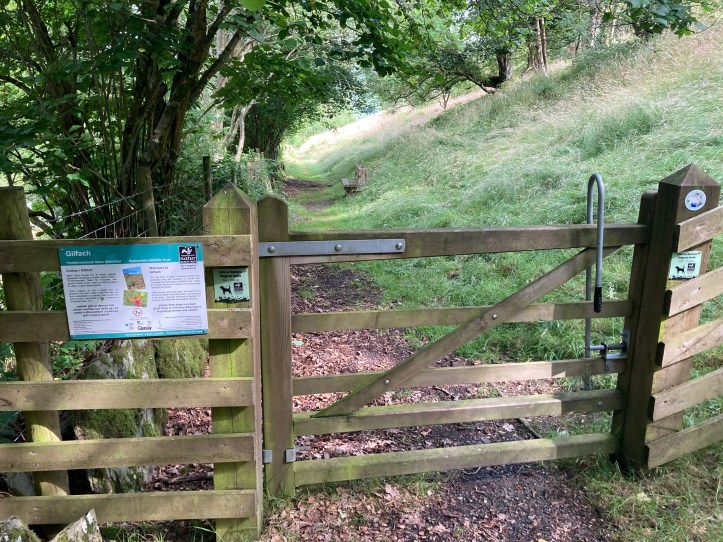

Having come down off the hill and followed the river through this preserve, where I saw perhaps twenty people in the course of half an hour (which is just a mindbogglingly large number of people to see in Wales after walking alone for days), I came to a road and a foodtruck. I kid you not. There was a big van by the side of the road, right near the parking lot entrance for the preserve, that was selling burgers and chips and whatnot. It was still too early for lunch, so I didn’t stop (I regret this now, not because I starved later but because one should eat from a foodtruck dropped into the middle of nowhere). RIght after the foodtruck, the trail dipped briefly down into the woods to the river, then up the other side to rise up onto the next hill. Here I met a man walking his dog (I know, you’ve read a lot about me and people walking their dogs… they tend to be more open to stopping to chat), and we had a nice chat. The foodtruck is such a fixture, he said, that he uses it when giving people walking directions. “I say, turn down the path at the burger van, and people often ask what’s a burger van. A van, I say, selling burgers.” This is the kind of dialogue we need more of in film and theater. He’s got that Mamet repeat-the-word thing going, and the rhythms of this man’s speech, with a rich Welsh accent, were fantastic. The downside of living in this remote area? The nearest hospital is forty miles away in Hereford. He recently had to get his eyes checked, and because they would be dilating his pupils, his wife had to take him because he wouldn’t have been able to drive home. The dilated pupils seemed like a stand-in worry for the larger point- the hospital is forty miles away!
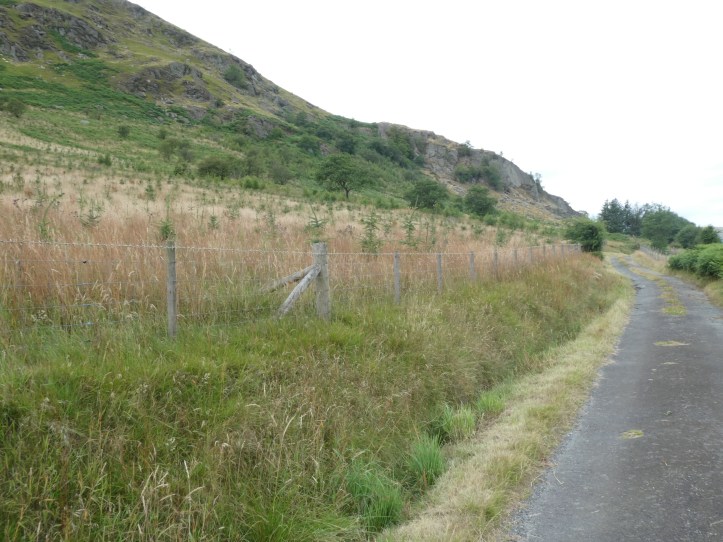
Once the path made it back up the hillside, it regained a minor farm road. The guidebooks in the UK describe these as “metalled roads.” That means a paved road. I don’t know why. I am not in the mood to do the research right now, at 6am as I write the previous day’s walk up, so if anyone wants to do some research on the reason the British, at least in walking guides, call minor paved roads “metalled,” please have at it.
From here on, the vast majority of the way to Llangurig is on these tiny back roads. Truly tiny. Several times I was almost climbing into the hedges to make way for a tractor pulling a trailer loaded with rolled up hay. Very exciting.
Along this road, I ran across a farmyard mystery.
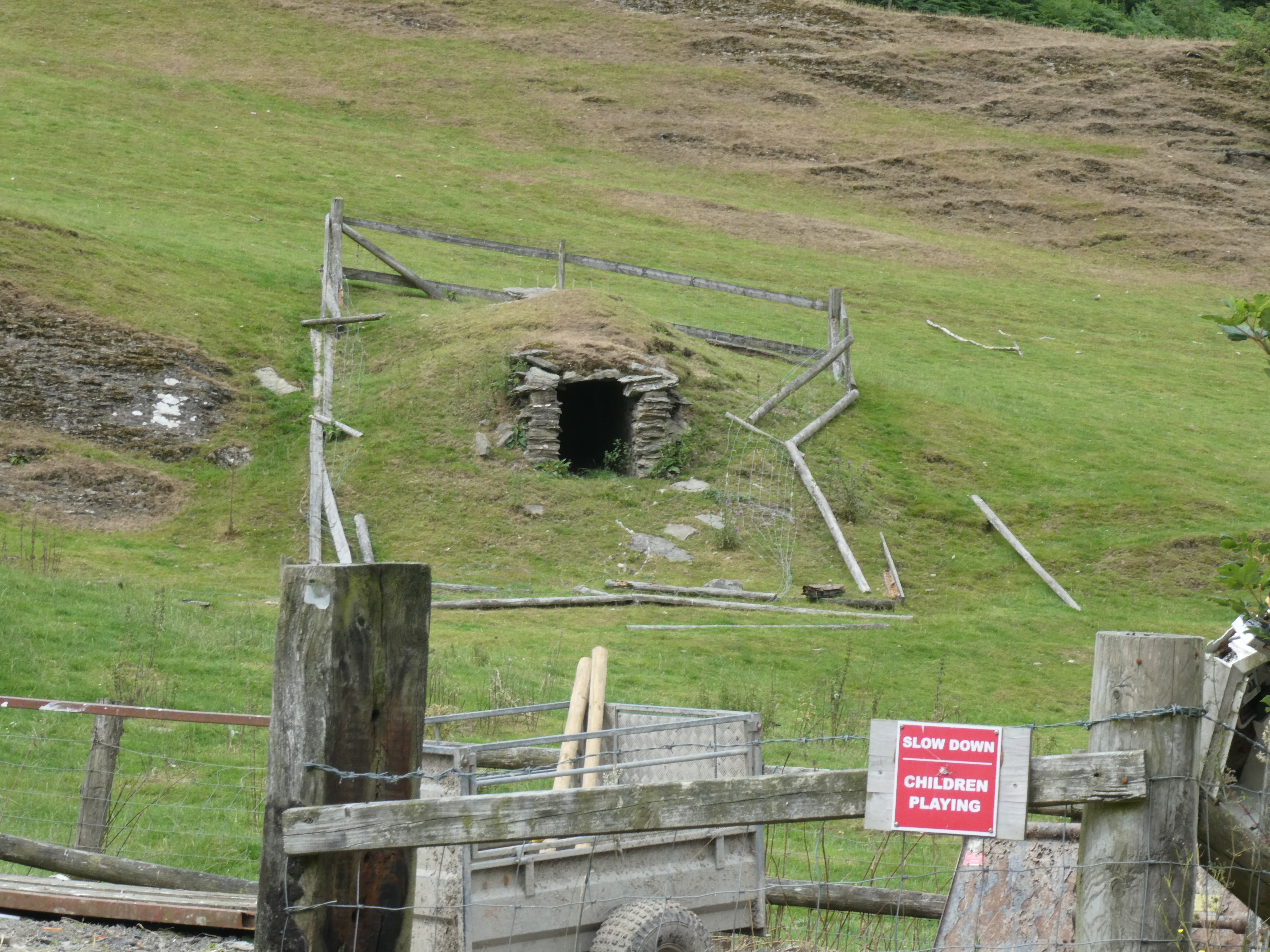
What is this stone cavelike structure for? Was it a stream outlet and the stones were put up to create a cooling box to keep things like butter cool? Is it an entrance to another dimension?
And for the second day in a row, I came to a decision point late in the day regarding whether to take the dramatic high road of the actual path or the gentler low road. This time, the guidebook flagged it.


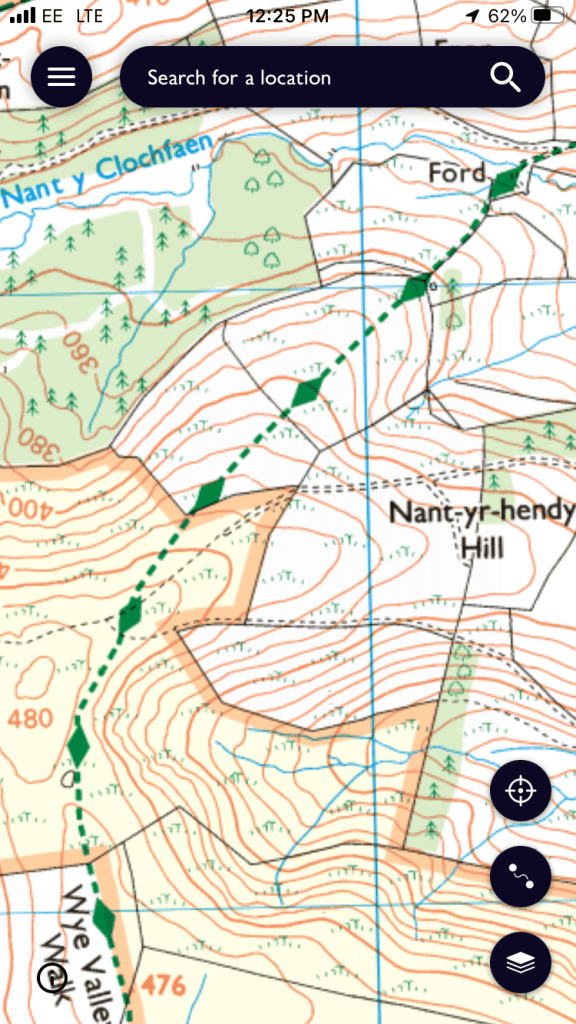
Just look at those topo lines, each marking ten meters of rise, at Blaen-y-cwm. And that descent around Nant-yr-hendy Hill is no picnic either. My heels were hot and sore, and so I opted for the road. It was still four miles of walking with a fair bit of up and down, but by the time I got to Llangurig, it felt like the right choice.

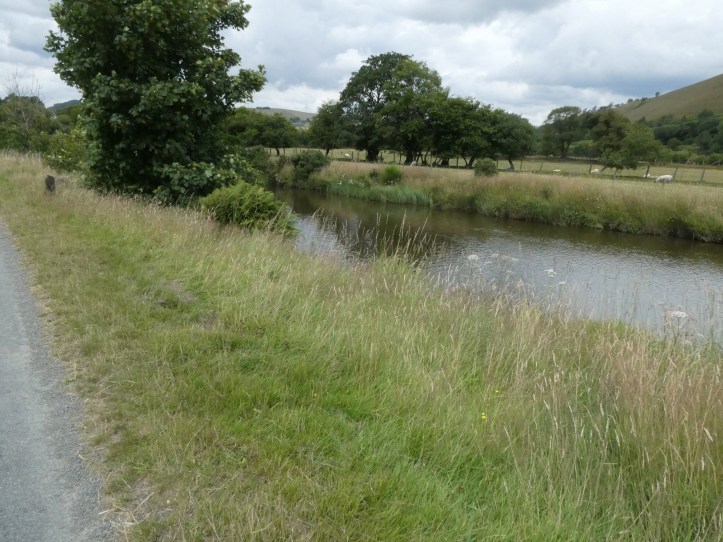
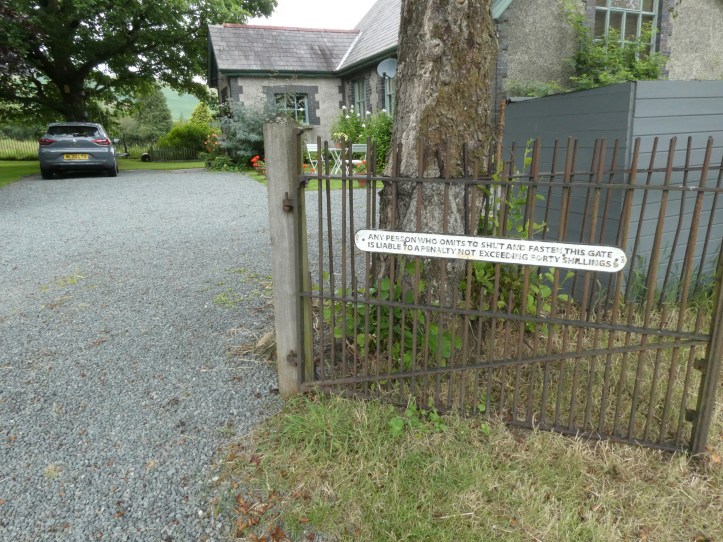
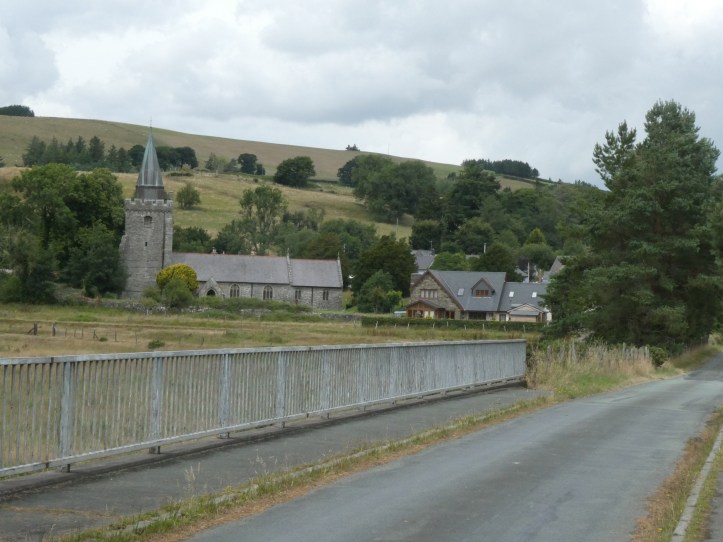
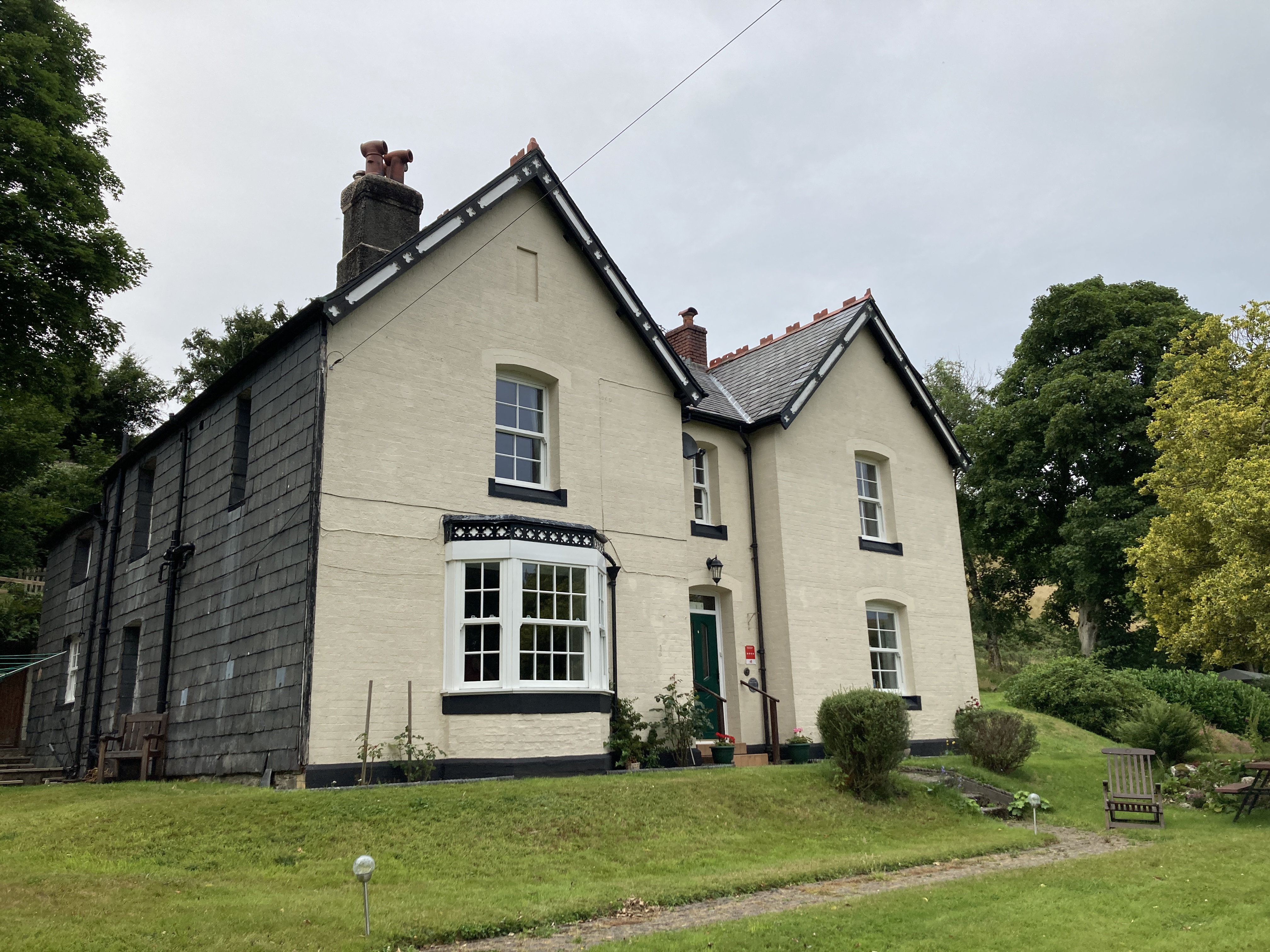
Alas, though it was only 2:30, the local shop/post office and the local tea room with all sorts of baked treats (at least to judge from their sign) were closed for the day. My B&B, the lovely Old Vicarage, had noted rooms available at 4pm. You can often be much earlier than these suggested times, but I figured 3:30 was about as early as I wanted to try, so I settled in a comfy spot and rested watching the world go by in sleepy Llangurig.
The local pub’s dinner options are slimmer than usual, and I wasn’t thrilled with the scampi, which is deep fried shrimp and in this iteration might best have been called fried breading with small pieces of shrimp tucked in there somewhere. But I am almost at the end, and in fact am staying here in Llangurig for two nights. In the morning, a taxi will take me 12 miles to the origin point of the trail and I will hike back to Llangurig. That’s the better way to do this last leg of the walk, because at trailhead there is no phone signal, so if you planned to walk from town up to the trailhead, you’d have to give the taxi a set time to pick you up and then spend your hike worrying about getting there on time. Instead, I’ll be driven up after breakfast and hike 12 miles back. And that, I am rather stunned to say, will be the completion of the Wye Valley Walk.
 ramblinghank
I know this is very “belated” but I find myself wishing to see you attempting to provide phonetic pronunciations for a heck of a lot of these towns and by-ways. One has to believe it might lead to some great opportunities for some dry humor 🙂
Indeed, I should say a bit about my efforts with Rhyd Y Benwch, and the general sense locally that no one refers to it that way, though my pronunciation is good– it’s the Hafron Forest to most people here, even thought the sign in the parking lot says “Rhyd Y Benwch”.
Per the online etymological dictionary, the term “road metal” refers to the broken stone or cinders used in the construction or repair of roads or railways, and is derived from the Latin metallum, which means both “mine” and “quarry”. The term originally referred to the process of creating a gravel roadway.
Thanks, Jeeves!