
Tonight, I was thinking about contingencies and how we deal with them. After a short day of hiking (about which I promise I am going to write in a minute), we arrived at the truly lovely Willowford Farm B&B, where we are staying in the converted milking barn next to the house. The long low milking barn, the house and the new barn form a charming little courtyard carefully watched by Alan, a black and white herding dog with a deep passion for fetch and a quiet calm. There’s not a bark out of him even as what must be dozens of hikers go by on the trail, which passes right outside his little courtyard fiefdom. He diplomatically ignores the cat, who has recently had a litter of adorable kittens who made a brief cameo before heading back into the barn, presumably for a catnap. I was so busy playing fetch with Alan, using a gnawed-at tennis ball and a bean bag and one thing that looked like a rock but was a much-loved rubber ball, that I never got a good photo of this very good dog. Shame on me. Alan, I should note, did the fetching, I did the throwing.
After resting a bit, we got alarming news from one of our hosts. The Samson Inn, with which this farm is associated and which is one of the only places to get dinner without driving at least three miles, had a catastrophic electrical failure. It would be closed for the night. The restaurant had had fifty reservations for the evening, so the few local options were going to be busy. But, our host offered, the refrigeration at the restaurant was still running on emergency generator and the chef had already done a lot of the food prep for the evening. We could, if we liked, order off the menu and they’d finish it off here in their home kitchen. There would be limitations, of course. No chips (french fries to us Americans) since they require a deep fryer. The steak wasn’t a go (not sure why on that one). But otherwise they’d try to accommodate.
They’ve got eight guests staying at this B&B, so it took a while to get this all conveyed and sorted out, for orders to be placed, and for food to be brought up from the restaurant (which is only a kilometer away, so the challenge wasn’t distance so much as packing mostly prepped meals in some way to put it in the back of a car). So, dinner was at eight, a very sophisticated time but late enough to try patience a bit. I mean, all the guests had been walking all day, and our party at least had been planning on dining at 6:30. But the host family did a good job of making it work, with even their very young daughter, perhaps age six, pitching in for a little waitstaff duty. Honestly, I’d say she was thrilled to carry out a few dessert and coffee orders. Don’t tell Child and Family Services! With a few bumps, the hosts dealt with contingency pretty darn well.
And that got me thinking about the contingency, slower bu on a much larger scale, of the Wall-building project. The Romans had 84 miles of frontier from sea to sea that they wanted to put a wall across. It’s rolling country with an impressive hard quarry-able rock in sections in the middle, steep drop-offs some places and long flat land in other places. There are rivers to bridge, little notches on which the wall would have to plummet down the side of a hill only to rise again. The surveying and decision making must have been hard enough, but then they had to find and quarry nearby stone, build roads where they hadn’t already to get the stone up to location, and build the damn thing. It certainly explains why they started with a wide foundation but then over they years decided on a narrower wall, something we can see because of the single course of foundation stones with a narrower wall built on them, something that seems to have happened a lot. In much of the western part, the wall was originally dirt, not stone, with wooden forts. They upgraded later, probably when the local Roman troops came back from visiting the stone forts to the east and said, we have to keep up with the Jonesia. (Little Latin joke there. Very little.)
And of course, as walkers, we are dealing with contingency on a small and large scale all the time. During today’s walk, we were in a section of the path still high on hills, though lower than yesterday’s hills, and the low hill line has led people to develop multiple paths on higher ground with the most stunning views, on middle ground not quite at the wall but a bit less challenging, and lower down. Which path is the right one? The wall isn’t always there as a marker of the right way, since some sections have been robbed out over the centuries for local building (why quarry more stone when the Romans have already cut you nice rectangular stones that would make a lovely house?) and others have collapsed or been covered over with dirt.
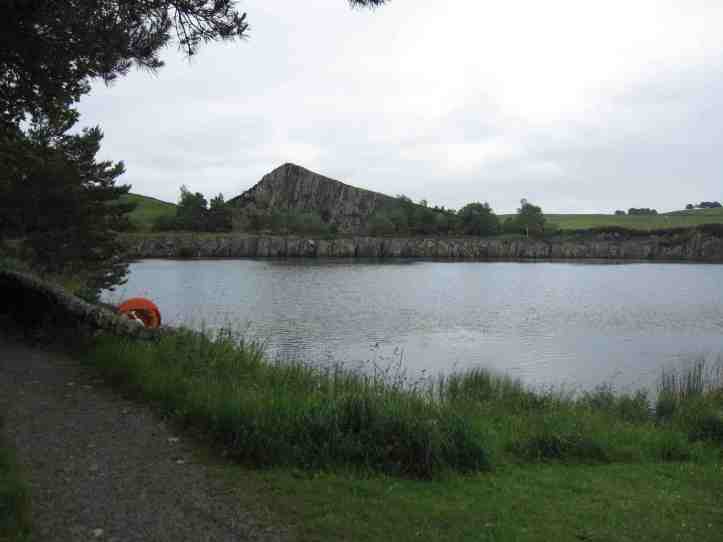
A few times, we were looking ahead and couldn’t quite decide what was ‘the real path’ and what was just wear in the grass from some walkers deciding on a different option. It wasn’t like we were going to get truly lost, except for one moment when my map-reading almost led us down the wrong side of a hill because I though we were about a half mile further along than we were. (That would have been an annoying detour!)
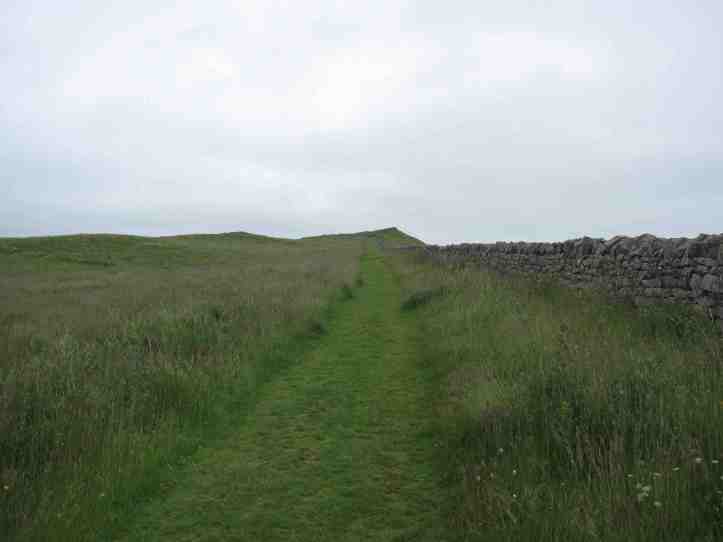
Mostly, it was a day of gentle descent. We started by walking up to the highest elevation on the entire wall in a quick quarter mile, then spent the next few hours going down for a while in a gentle descent, then a plunge for a little dip, then up but not regaining all the elevation, then down some more. We have become so jaded we have to remind ourselves to goggle and wonder at the wall, some original, some part of a massive 19th century restoration project of rebuilding places where the wall had fallen into disrepair, sometimes following a wall that isn’t Roman at all, clearly identifiable by the less regimented shapes of the stones.

We stopped for lunch at the ruins of an old castle (not a very big one, to be honest) nestled in a valley where we seem to have truly abandoned the hard rock line of hills that dominated the last day and a half. The castle was hopping–a group of energetic children of around 5 or 6 with some adults trying to herd them, two men with some fancy tech doing a 3D scan of the building with a camera that slowly swept back and forth. And us, contently eating our snack bars and trying to pretend that the ground we were sitting on had never ever ever been the site of sheep doing their business.

Today’s walk was eight or so miles. Possibly as much as nine? We can’t get an accurate, since our accommodations aren’t necessarily in the town which is one of the points referenced in mileage estimates- so, today was from the Twice Brewed Pub and Hotel to Willowford Farm, but that isn’t the same as what the trail guide says we are doing, which is Steel Rig to Gilsland. And our various phone apps and Fitbits and iWatches suggest that we four siblings have been walking four different routes. My phone must think I need positive reinforcement, because every day my counted mileage on the phone is higher than anyone else’s by a couple of miles. A couple of MILES.
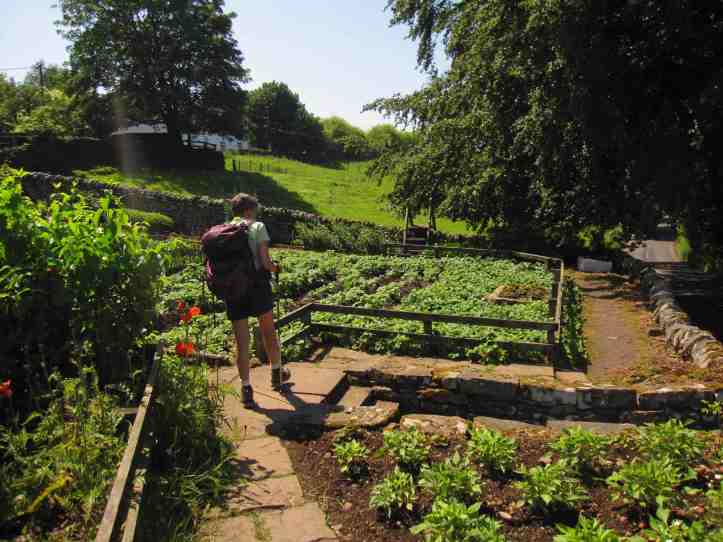
The last little bit is of the walk today had a lot more human life around us- passing through a farmyard instead of being far off in a field with sheep that indicate there is a farm nearby. And in the last mile, we went through a town, and in fact through someone’s front garden.
Tomorrow is another short day. We are starting late because there is a preserved fort about a kilometer from our B&B that doesn’t open until 10am. This time, unlike our mad dash through the wind and the rain at Housesteads, we intend to actually learn something and get a clearer sense of Roman fort life. Once we become experts on all things Roman garrison life, we have about seven miles to cover (eight? six and a half? seven and a half?). Assuming we don’t have to modify the plan to deal with any contingencies.
 ramblinghank
Nice work, everyone! Always fun to read your blog, Hank. I love your thoughtful digressions (contingencies, etc…). The blister sorcery comments have faded, so hopefully everyone’s sore spots are manageable. Enjoy the rest of your hike!