As anyone who follows me on Facebook will attest, I walk a lot. Within the limits of Chicago’s weather, I walk most of the year. And though I like a short jaunt around the neighborhood, what I really like is a walk that lasts at least an hour, sometimes stretching out across a whole morning. But I’ve lived in the same city for 30 years, and in the same neighborhood for 18, so except when I get on a bus or a train to get to a fresh starting point, many of my walks are on familiar ground, past landmarks I know. There’s the house with the weird paint job. There’s the funny little park with the big statue, planted in the midst of a residential neighborhood (well, that’s a hundred parks in Chicago, but you see what I mean). There’s that building that used to be a really good bakery but now houses some sort of health services clinic.
But the rambles for which this website is named are all to places quite new to me. No matter how you read up in the guidebooks and study the maps and learn the goddamn archaeological and geographical and geological lingo, every walk is a continuous unfolding of surprise. Cresting each new hilltop, I don’t know what will appear; it could be a gentle slope down which I can easily amble with my walking poles swinging in easy rhythm, or a plunge down a set of stone steps laid into the hillside because it is so damn steep that the verbs to describe your descent are plunge, navigate, manage, fall. Each new turn in the path might reveal, say, a bunch of cows standing right where you need to pass, or a little copse of trees, or just another field covered in sheep shit. I cannot stress enough the sheer volume of sheep shit you see on a ramble anywhere in England. Those little buggers fertilize this land.
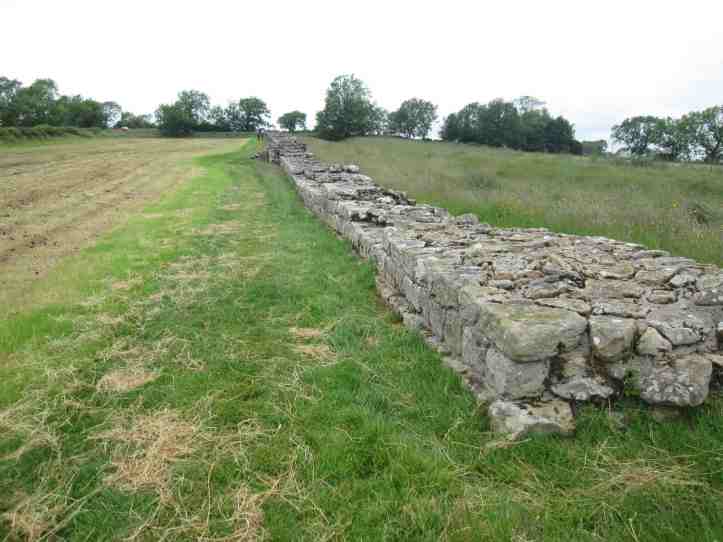
So today’s walk was filled with surprises. Even though we were walking along the route of a Roman wall, each new encounter with a bit of preserved wall was like a little present. And if wall remains are presents, this stretch of the path is like Christmas and your birthday rolled into one. We didn’t get jaded, but we certainly became discriminating consumers of ruins. By the time we got to a massive preserved fort at Housesteads, we’d seen enough wall and turret and milecastle (again, don’t let that name fool you- a milecastle is more like a very small outpost, about the size of a house) that we blew through those ruins like tourists pouring off a bus tour, ready to take a few photos and not process all the information on the little signs that pepper the site. Granted, it was late in the day when we got to Housesteads, and the wind was kicking up, and it was starting to rain a little, and the temperature seemed to drop about ten degrees in just a few minutes. So trying to sort out the difference between the barracks house, the commander’s residence, the bathhouse, and the granary, all of which were an outline of stones rising no more than a few feet, held less allure than it otherwise might.
Housesteads, about which we can say they have a gift shop that sells both Diet Coke and Hadrian’s Wall refrigerator magnets, both of which I bought. Beyond that I can say that Roman forts are big, and they can be on a hillside, staggered like an exotic villa on different levels hugging the hill.
Part of the reason this section of the wall is so well preserved, I’d guess, is that the wall sits on the edge of a long line of hills that must be the edge of a geological formation of some kind, because the wall often runs along a drop so steep it amounts to a cliff. Who the hell was going to haul their asses up these rough rollercoaster hills to rob out the cut stone of the wall for re-use. Well, as it turns out, a lot of local farmers did just that over the centuries, but fewer than did that same thing in the flat lands near Newcastle or the more gentle hills of yesterday’s walk.
Today’s walk started with an unexpected bit of road-walking, perhaps a mile and a half of literally being right on the edge of the road or on a slim sidewalk, before cutting off across the wilds. Because the wall followed a natural east-west line, we were never far from an east-west road, but in today’s section, when people came to build roads after the Romans had abandoned the frontier (what with the collapse of the empire and all), they often built lower down in valleys rather than follow the challenging line of the wall.
The wall is going to follow the high edge of those hills up ahead.
In the photo above, you can make out a line of bumps- that’s the leading edge of a geological formation that means the hill rises from the left to a high point, then drops off suddenly. The wall follows that line at the drop. Which means we follow that line, up and down the steep rolls, with a steep drop on our right for hours. It is not like we were right at a cliff’s edge, but for a long stretch we could feel and see the land to our right (to the north) a hundred to several hundred feet below.
The forecast had called for rain, but after yesterday’s fog, today’s overcast skies were a gift, giving us long perspectives on the landscape in all directions.
And the ruins. You can’t wrap your head around the scale of this undertaking unless you walk it. Driving coast to coast on the roads near the wall, you could do the full length of the wall (84 miles) in a few hours. But the Romans built it stone by stone, hauled up to some of these more remote locations from nearby quarries.
The ruins also convey that the wall was a place where people lived: Not just soldiers in the camps, but also the communities that sprang up around the forts and of course the locals who already lived in the area. The Romans left the easiest archaeological evidence to read, because of their regimented building habits. Most Roman forts around the entire empire follows a similar basic plan, so when you dig up a new fort, it is easy enough to work out what you’ve got.
The surprise, I should stress, is not just “Yay! Something new!” It’s also, “Good lord, a hill so steep someone hauled rocks up and made a staircase in the middle of nowhere!” or “A 30% chance of rain can mean 30% of my body is soaking wet!” or “Jeez, that stone laid in the muck as a place to put your foot actually rocks back and forth!”
We hiked a bit more than 12 miles today, a similar distance to yesterday’s hike, but it felt longer because of the hard little ups and downs, which are cleverly clustered late in the day. Whoever decided on the breaking points for days of walking has a sadistic streak. Our pace was slower, partly because Rob is still nursing a blister on his foot that’s placed to make hard ascents and descents even harder, but also partly because this was a day to stop and look at ruins and read what signage there is. At the end of the day, Rob was lagging behind a bit, and he wisely found place where the paths diverged and, with his wayfinding skills (leading Boy Scouts on wilderness hikes pays off for Rob!), he determined that while Tracy, Karen and I did the stairmaster from hell for the last mile and a half, he could hike a lower path with less up and down. Here’s what he saved himself from:
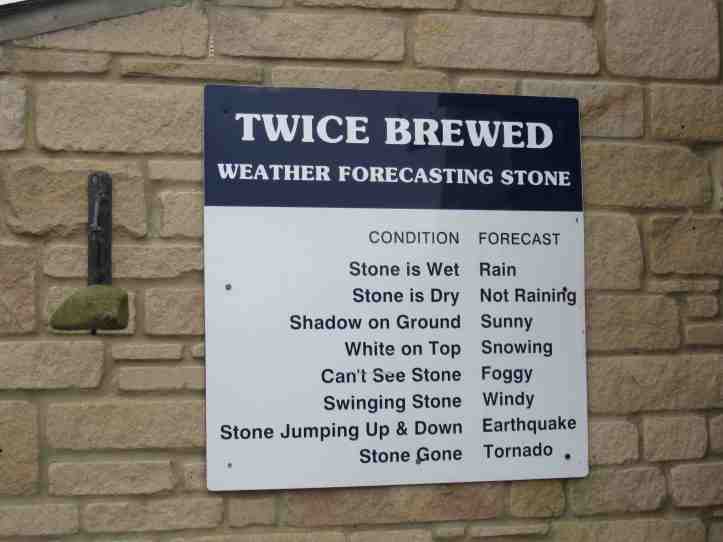
We met up just after that mini-Eiger-North-Face with uncannily perfect timing– Rob had texted to assure us that he was on the low road, and we thought we’d simply meet at the hotel, but as we started down the last gentle hillside after that vertical plunge, we saw Rob strolling along on the lower path, perfectly timed so that we simply reconnected about 400 yards before arriving at Twice Brewed, a lovely brewery/hotel with an unexpectedly delicious menu. Try the goat cheese and roasted tomato tart appetizer. Trust me on this.
Tomorrow is the first of two blessedly short days, with just eight miles of walking each. We can take it easy and really enjoy the scenery. And the weather, whatever it might be, will be just one more surprise.
 ramblinghank