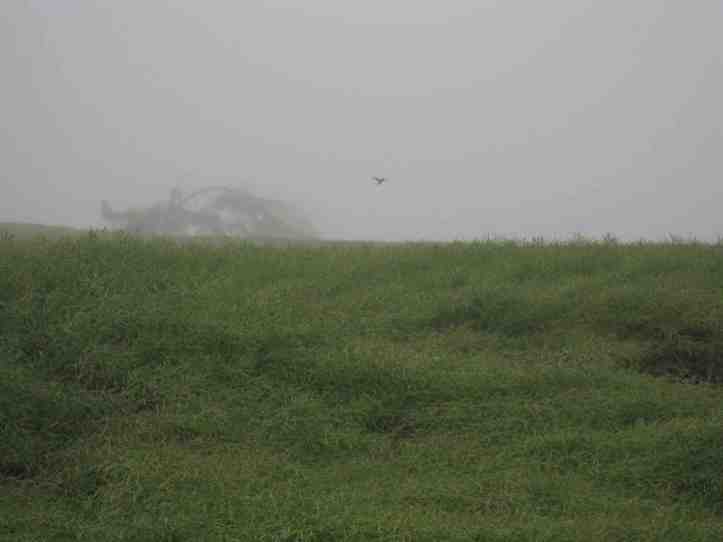
Our theme for day two, a walk from our B&B just outside Heddon-on-the-Wall to the village of Wall (are you detecting a theme in place names?), is trying to bring what you see into sharp focus. The day began with what I thought might just be morning fog that would burn off. Not quite rain, but very damp and cloaking everything in even the middle distance in a soft blur. The grass was damp, the air was damp, and soon we were damp. And that mist held for most of the day, giving the whole hike the vague feeling that we might stumble upon Brigadoon just over the next rise.
At the same time, we were trying to learn to read the landscape for its archaeological meaning. Hadrian’s Wall wasn’t just a big stone wall: If you imagine it as across-section, there was a ditch to the north of the wall, deep and steep, to make it hard for those to the north to approach the wall at a run in an attack. Then the wall, made of stone that was carefully laid in courses. Then there was a Roman soldiers’ road, which was, like many Roman roads, slightly elevated. Then there was a hump of dirt, a deep ditch called a vallum (much hilarity over the difference between vallum, vellum, and Valium), and another hump (the two humps on either side of the vallum made, of course, with the dirt dug out to create the vallum). And of course along this line of rises and falls in the landscape cutting across from east to west in the landscape there were milecastles (small structures for a limited guard) roughly every Roman mile, and forts dotted at longer intervals, where a larger number of troops (80 men in a Century–but that’s another story about etymology) were housed.
Woof. Lot to see, right? Except of course that was what was here roughly 1800 years ago. History does not allow for simply preserving such a massive building project across 84 miles. Stones were robbed from the wall to build houses and other buildings from the medieval period onward, and when people wanted to build roads, the foundation of the wall itself, mostly stripped of its stone, made a perfect base for a road. And the ditch to the north of the wall and the vallum often got filled in to be absorbed into farm fields. MIlecastles mostly disappeared completely, and forts were often reduced to simply foundation outlines that gradually got buried under the sod.


So, for us, that meant day two was about trying to discern what in the landscape was wall-related. The path toggles back and forth across a paved road, which literally follows the road’s foundation for miles. So sometimes we were walking next to the first defensive ditch to the north of the Wall (now road), sometimes we were to the south and seeing traces of the vallum. Sometimes we saw areas of bumps in the landscape that might have been mileforts, or perhaps could have been later medieval building. And of course, this being a long-inhabited landscape, one shouldn’t rule out the occasional iron age burial mound…
So a lot of our conversation was something like “Ditch?” “Vallum? I think.” This despite all fo us having read at least a bit about the Wall, and two of us having devoured a whole book on the history of the Wall a few months ago (too early, apparently, to retain enough detail for the walk). But walking in rolling countryside, seeing sheep and flowers and some cows on a misty day, with just a short bit of actual rain, speculating on the meaning of the landscape, is not a bad way to spend a day.


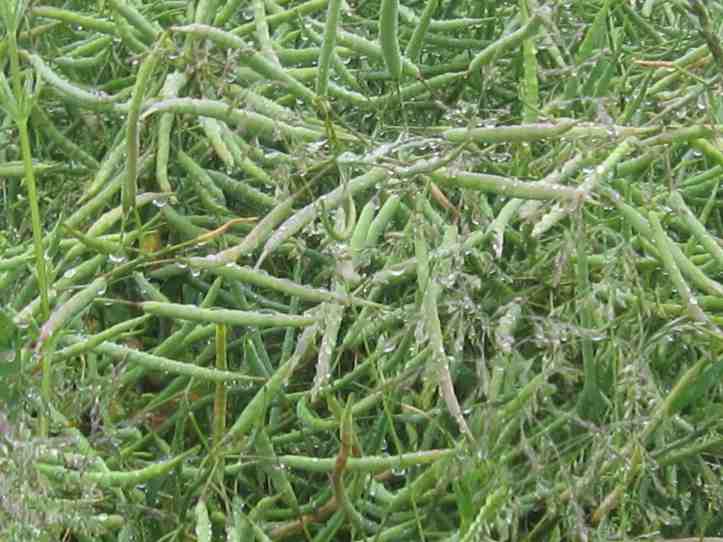
Adding to the fun, we have established that we are not the most botanically educated foursome you could put together. Yes, we can tell the difference between beans and grain broadly speaking (certainly when the beans are mature), but what grain? Oats? Wheat? What the heck is Durham wheat? Rye?

Our strategy for leading and following today was to swap out the lead position so that the leader would, after a time, drop back to last position so that leading rotated. We have different walking paces for sure. I’d say Tracy is the fastest walker, Karen and I have a similar pace, and Rob’s pace is generally a bit slower. And today the difference was more pronounced as Rob was developing a blister on the pad of his foot, which made descents down slopes and climbs over stiles a study in trying to minimize the developing blister. We have worked out that it is okay to spread out the line, so sometimes we were sprawled across fifty yards of trail, often with two pairs of people in two different conversations (both conversations involving a lot of “Is that vallum or just a little roll in the landscape?”)
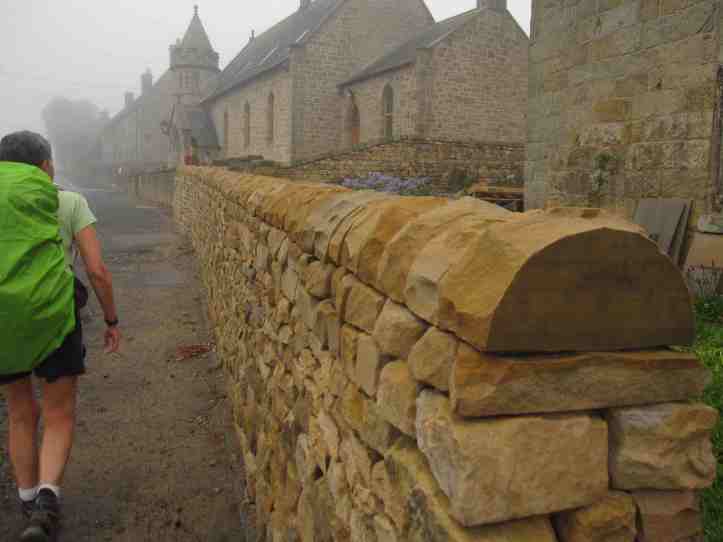
To reinforce the impressiveness of the undertaking of building a wall, we encountered three modern masons at work crafting a really beautifully constructed wall in front of some cottages in a little cluster of houses and a church that do not merit even the label village. A hamlet, maybe?
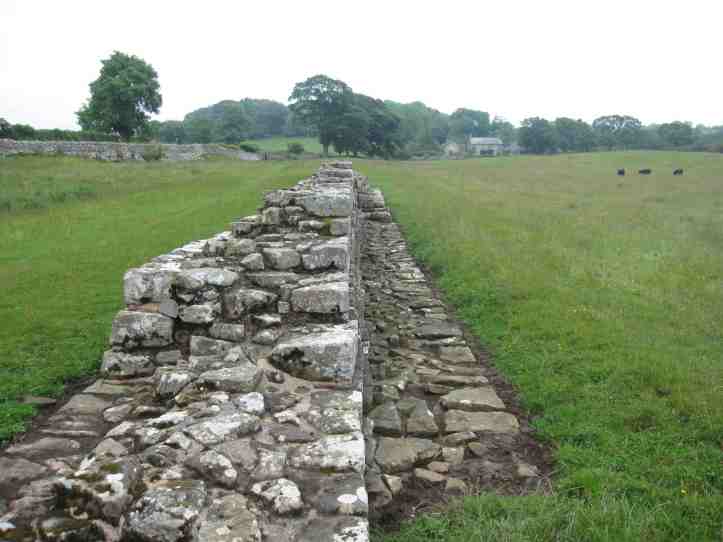
And later in the day, the path offers a short but dramatic stretch of preserved wall where the road (for whatever reason) has veered off and is built to the north of the wall, saving this bit. It’s especially helpful, because it shows how the wall was a long-term project: The original planned width can be seen in the wider course of foundation, but that must have seemed like too much work (or perhaps the contractor gave the Romans an overly optimistic quote on pricing and had to scale back?), so the width was reduced some time in the construction era (the 200s, I think?), as indicated by the surviving courses of stonework seen in this photo.
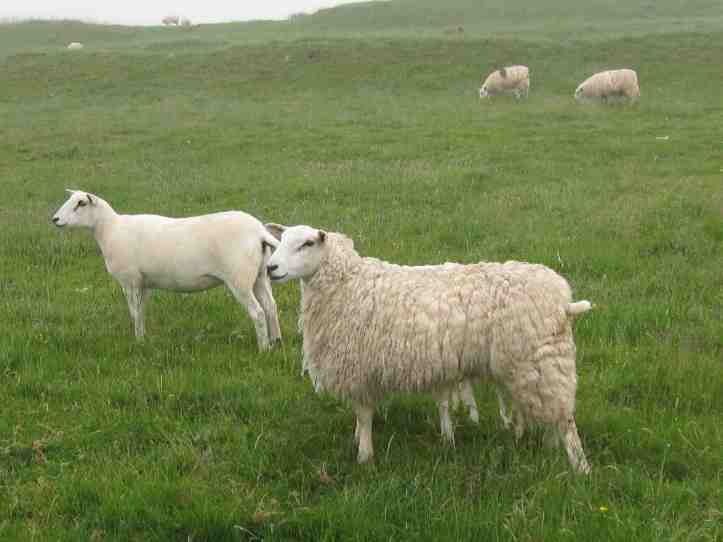
We aren’t that far from a spring lambing, so there are young lambs mixed in with the sheep, which means hearing and seeing some cute lambs bleating and bolting on our approach. I cannot fully explain why sheep are so damn entertaining, but over ten years of walking, I have taken hundreds of photos of them. And it’s not like there’s some huge variety in those photos. But here you go anyway:
Over the course of the day, we encountered perhaps fifteen walkers going in the other direction, some with packs and rain gear, some perhaps just out for a day hike in jeans. And we met two women going westward like us, who we overtook at a stile where they had paused. With a little of the usual trail chat (once you here an accent that isn’t English or Scottish, it’s ‘where are you from?’), we established that they are from Chicago. Interesting coincidence, we noted, so is Hank. What part? Edgewater. You’re kidding! It turns out one of them is the owner of Gethsemane Garden Center, a beloved institution about six blocks from my home. They are also finishing on Saturday, so we may well run into them again.
The walk was about twelve miles today, and ended with a walk through the village of Wall to reach our hotel, the Hadrian Hotel, which is lovely and quaint downstairs, all dark wood and comfy leather sofas and the smell of a fire, but with very nice modern rooms upstairs, carved out of this building which dates to the 18th century.
Rob has drained his blister and will be using all sorts of fancy medkit moleskin-related sorcery to prevent it from getting worse, so tomorrow’s walk should be more pleasant for him. Fingers crossed. And the forecast calls for actual rain, but who knows what we’ll get. Tomorrow is packed with ruins of several forts that are dug up and preserved, so expect pictures that look more like we are touring a massive Roman building project rather than just walking through a foggy, wet landscape.
 ramblinghank