This is the second-to-last day of walking, and the good people at Contours, which scheduled my trip, tease with a light 14-mile day before the big wallop of 19 miles on the final day walking down to the sea. This is also the arrival, after 30 or so miles of walking the fields and hills and valleys, back on moor country, rising onto Exmoor. Dartmoor is by far the larger of the two moors, and it took two and a half days to walk across it (cf. Days 10 to 12). I’ll cover Exmoor in just a day and a half.

Like Saturday’s walk (except without the hail storm…), today’s walk was cool. People at all my accommodations have been remarking on two aspects of weather: how wet it has been for the last four or five weeks, and how unusually cool it has been this last week or so. The former has given me the gift of mud and squish and squelch; the latter has meant that I don’t get overheated even as I haul up a half a mile of steadily climbing path, and I sometimes wear my rain jacket for warmth.
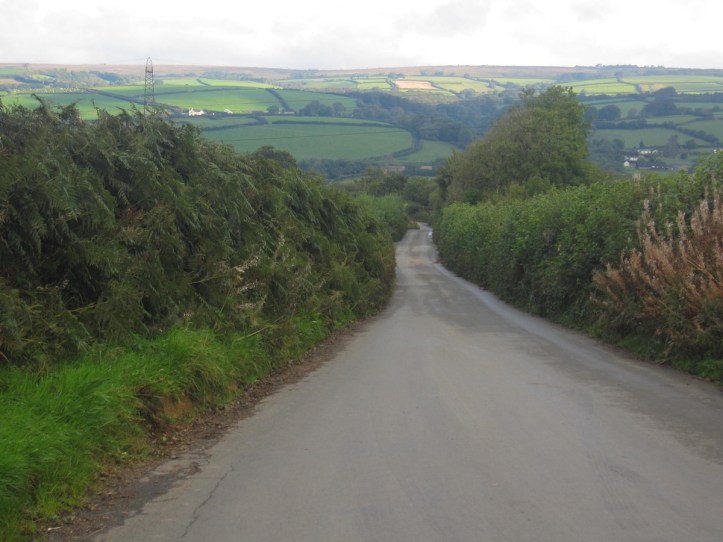
One of the entertainments of walking with a guidebook is working out the language. There are the words for landscape that you rarely encounter unless you read a lot of 19th English literature set in the country (Say, Thomas Hardy). You walk alongside leats and through combes, you climb over stiles and go through kissing gates, through copses of gorse.

And there is the wide-ranging and subtly shaded terminology and phrasing, about which I’ve written on past trips. A quick primer:
Road – It’s paved, and might even have a bit of grass on either side for you to bolt onto to get out of the way when a car is passing at a speed that seems totally inappropriate for such a peaceful rural place. What do you think this is, buddy, a freeway?
Lane – It is paved, but narrow and probably has hedges or walls tightly enclosing it. You will end up leaning into a hedge when a farmer in a beat-up Land Rover drives past. The hedge will have stinging nettle or spiky thorn bushes woven into it in such a way that you cannot avoid them.
Track – There is dirt underfoot, but people have also tried to keep it from being washed away by laying out large stones from three to ten inches across, which have now settled into the road making the surface a fun series of micro-adjustments as your foot comes down at an odd angle.
Bridleway – You’re sharing this trail with horses, which means you are walking through horseshit.
Path – Dirt underfoot, which in the case of this walk often means some mud, and when it goes across fields, you are walking in cowshit.
Greenway – A stretch of path that has trees planted on either side, making it a covered way.
often muddy – Ha! Given that the entire way has been to one degree or another muddy, “often muddy” means mud is now three to four inches deep, with no place on either side of the path that is any better. Your boots will be a whole different color after you get through these stretches, and you will likely end up taking advantage of tall grass in fields ahead to walk in a sort of wiping motion to get the muck off. It won’t work.
rising gradually – You will spend the next thirty minutes in a state of perpetual anticipation, thinking every few minutes that surely by now, where it seems to be cresting ahead, you have reached the top, only to find that the path turns a bit and there is another rise
rising swiftly – These are the hills that were the inspiration for the Stairmaster exercise machine, climbing ruthlessly at forty degrees or worse, making men of a certain age take steady huffing breaths with each step.
descend steeply – Say goodbye to your knees.
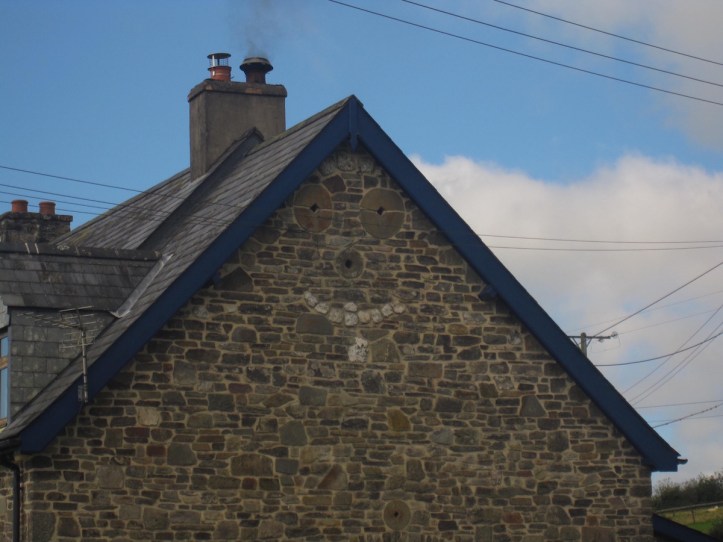
Joking aside, it was really a lovely day of walking, cool but dry, with rolling hills and enough variety to keep things interesting. The miles rolled by, with just a few sightings of people but a lot of walking near farms and through tiny ‘villages’ (often just six or seven houses and perhaps an old church).
After a morning of really moving quickly (relatively speaking, of course), I arrived at the ‘official’ start of the Exmoor portion of the walk. So far, this moor has a different feel from Dartmoor, though of course I’ve only seen three or four miles of it. On the moortop bit of walking I did today, there was a lot more tall scrub and some trees and even a fenced area off to one side, suggesting that someone owns and uses land here. Compare that to the blasted wilderness of my days on top of Dartmoor.
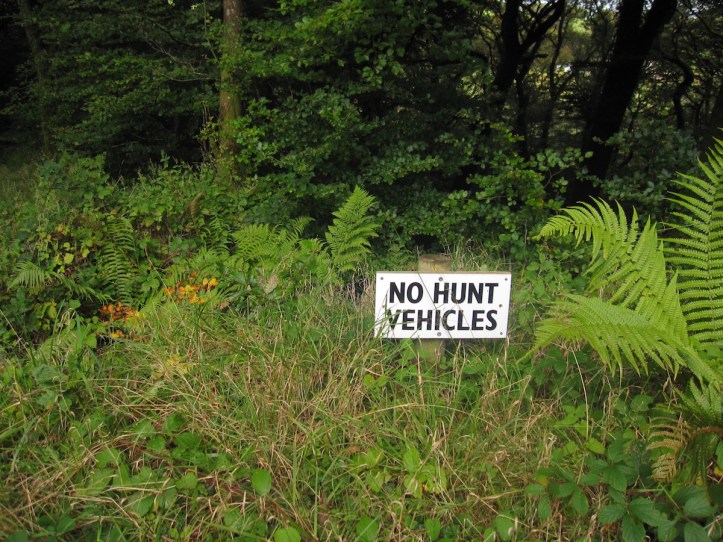
Then, after a brief stretch on top, the path descended steeply in an area that is often muddy (double whammy!) to cross a river valley, and then ascended again toward Withypool. For the second day in a row, I heard gunfire, and later in the evening I learned that in this area there is a fair bit of hunting as a business: people pay to go out and shoot. I think they’d be shooting grouse and pheasant mostly, based on what I’ve seen.
In the last mile, I ascended gently onto Withypool Hill, where, the guide claimed, I might see Exmoor ponies. I am a sucker for the small ponies that you get on paths in hilly regions (I’ve seen them in the Cotswolds and Wales and the South Downs and now in Cornwall and Devon). But unless the ponies were traveling incognito in clever sheep disguises, I saw no ponies. Aw. But the guide says about the start of tomorrow’s walk that I might see them along the section that winds alongside a river beyond Withypool.

Tonight’s accommodation, The Royal Oak in Withypool, has a full-size bed AND a bathtub, the first tub I have seen the whole trip. I contemplated a bath, but feared I’d never get out again, so I just relished the extra space, for once not showering in a stall the size of a coffin. I had a pleasant dinner in the quiet pub/restaurant, listening to a couple here on holiday chat with the barkeep about the local hunting, and also listening to a group of four tourists from somewhere in Scandinavia, entertaining myself by trying to decide what language they were speaking, Swedish or Norwegian (I know enough German to know it wasn’t anything Germanic). Since I have no grasp of either language, this game was based on a bizarre and limited set of knowledge and stereotypes about Swedes and Norwegians.
Tomorrow, I finish that day at the ocean. I can hardly believe the walk is almost over.
 ramblinghank
On to the ocean😄
Scandinavian languages are similar enough to one another that (1) it’s hard for non-speaker to tell the difference sometimes and (2) they might well have each been speaking a different Scandinavian language and understood each other just fine. At least so I was told repeatedly when I wandered through Norway, Sweden, and Denmark on one trip.