One downside of our rooms above the pub: No drying facilities for clothes or, gasp, shoes. We hung out our clothes over any surface, took the insoles out of the boots, used toilet paper to blot the insides of the boots, and left them out to air overnight, so both our rooms looked like someone’s mudroom had exploded. And in the morning, my room at least smelled like wet dog. Ah, trail life.
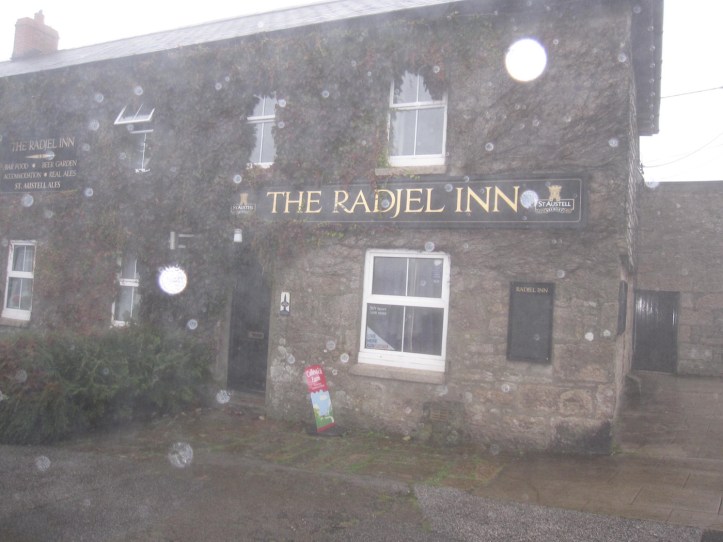
In a rush to start, we’d opted against waiting until the usual breakfast hour of 8:30, so our hosts had graciously left a cooler bag with milk and cereal in the hall outside our rooms. After a breakfast of cereal and a banana, we set off. First stop, the little convenient newsagent down the road, which we had affirmed in the evening opened at 7am. So, a bit before 8am, for later consumption, we bought a few Cadbury fruit and nut chocolate bars (yum) and a Diet Coke to feed my low-dose caffeine addiction.
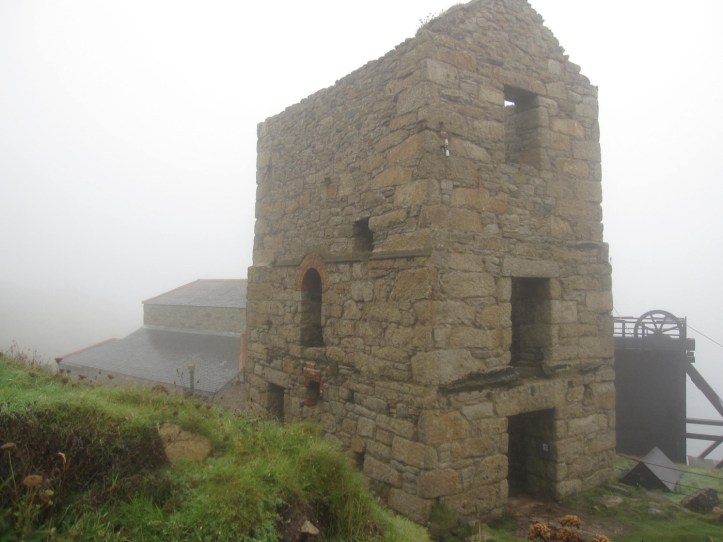
The weather was still very misty—not quite rain, but damp and cool. We had looked over the maps and worked out that we could rejoin the trail without retracing our steps by doing a little road walking. It seemed like avoiding going back to go forward. Ultimately I am not sure it saved us much mileage, but we did have an adventure at the Levant Mine and Beam Engine National Historic Trust Site, where we were rejoining the path. It turned out that the path, which the trail guide said passed through the site, was hard to find, and though we set out on a coastal path in the right direction, for the first 45 minutes or so, I believe we were on a secondary path that ran closer to the sea, and in a few places demanded harrowing climbs over huge rocks to go forward.
 But after a particularly crazy scramble, we kept an eye for any path leading a bit up and more inland, and finally re-found the trail. That first upside-down acorn marker got a cheer from both of us. It was still somewhere between mist and outright fog, and we walked for a long time through a surreal landscape of ruins of old tin mines. (If you’ve watched the recent “Poldark” on PBS, the show about the lovable rogue in 18th Century Cornwall, this is where they did a lot of filming of the seaside and mines.)
The trail is in fact much easier, with long smooth stretches of gentle increase and decrease in elevation, and sometimes almost like a cartpath, a real change from yesterdays’ wilder trail. We’re still going through tighter sections of trail, and in this part of the country, stinging nettle thrives and seems to have gained enough sentience to grow with stems pointing out into the path at shin height, the better to torment walkers who, like both Karen and me, prefer to walking shorts. Ouch.
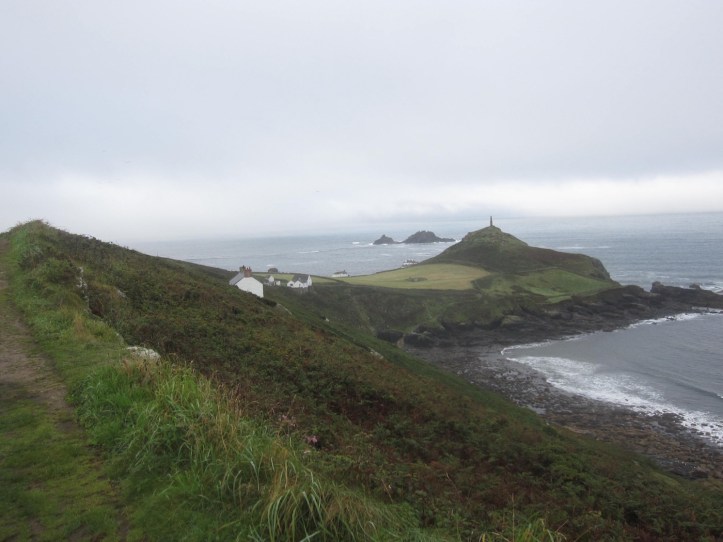
The day got clearer as we moved on toward Cape Cornwall, and the sea breezes are refreshing and keep us from getting overheated. And we passed by, but only briefly saw, the Cape Cornwall golf course. (It seems like I walk past or sometimes through a golf course on every trip. I have no deep insight about this, and simply note it in passing.) In this part of the coast, the land seems generally more open, with long stretches of the path having longer views than on day one. But there are places, like the stretch after Cape Cornwall, where the trail hugs closer to the sides of the hills as you descend and move inland at the same time to account for inlets where you cross water at a low point, then rise up the other side as the coast line reaches its fingers out into the sea again. The trail is green and lovely, but still has stretches of walking over rocks in the path, where every step is a little calculation about how to put your foot down correctly. After training with a lot of smooth flat paths and paved trails, that proves mentally and physically taxing.
The path eventually brought us to Sennen Beach and the town of Sennen Cove, which has surf and sail shops mixed in with places to buy Cornish pasties and fish and chips. It feels not exactly touristy—the people here are a mix of surfers and sailboarder types and people walking around wondering when the sky will fully clear and the sunny weather they’d hoped for will come.
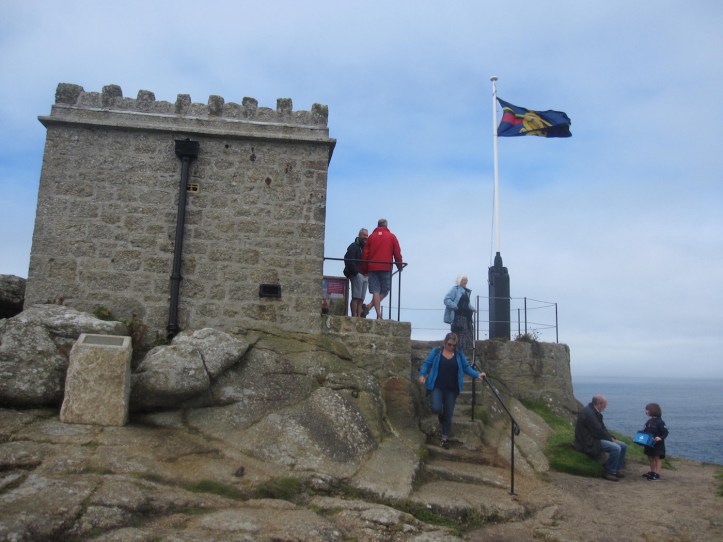
After passing through town, we rose on the path up to Land’s End, the dramatic point furthest west on the English mainland (the Isles of Scilly – that’s pronounced Silly—are out there somewhere to the west but not visible, at least not today). Tons of tourists wandering out on the path on short walks in utterly inappropriate footwear, God love them, and lots of families with children and very happy dogs (So many smells!) As we got very close to the building that marks that farthest point west with a sign indicating distance to New York (photo op, but not for us because we didn’t want to face the dozens of people and 50 extra yards from the path), we saw a stroller beside the hilly path, as though someone thought these paths would be stroller-manageable, realized they weren’t going to get far on this more rugged path (relatively speaking: by our standards it was easy peasy walking), and simply carried the infant or toddler, leaving the stroller to reclaim on their way back.
Land’s End is in fact a built-up tourist trap, an engine for the extraction of pounds from wallets, with a big visitor center/restaurant and further down the coast by about fifty yards, a petting zoo/pottery shop. We were briefly worried that we’d lost the path as we walked toward the llamas and little ponies on a concrete drive, and when we saw a path marker, I declared out loud, apparently in a too-loud American voice, “I am so happy.” A woman walking toward the petting zoo whom we were passing seemed amused at how happy I could be over a petting zoo, or a sign with an acorn on it, or whatever. But I didn’t care.
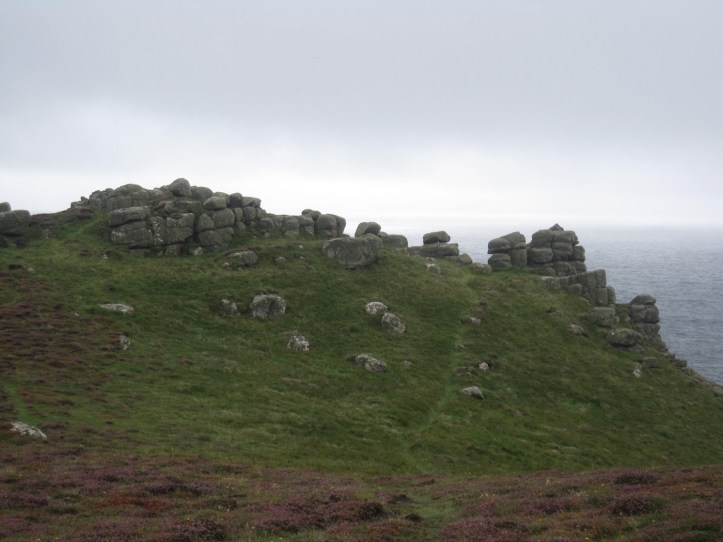 After quickly shedding tourists, the path went through a beautiful high clifftop stretch, turning gradually eastward as we rounded the point. We passed this amazing gap in the rocks, unaware that it’s a well-known photo opportunity—the Nanjizel Beach and Song of the Sea Cave. I don’t care how often it’s been photographed, I thought it was cool.

From here it was just another three and a half miles of mostly very pleasant walking to get to the Minnack Theatre and the small town of Porthcurno, our stopping point for the night. The Minnack is an open-air amphitheatre in which they do all sorts of plays. Monday night was “The Country Wife,” a 17th Century comedy. We’d actually researched this and bought tickets in advance, which weren’t too expensive (10 pounds, I think), but as we climbed down the insane path from the theater to the beach, and saw people actually doing it butt-style (sit down on a stair to get down to the next big stone stair), and as we made our way up from the cute little Porthcurno beach to the town, we both knew we’d be skipping the play. The way back to the theater would not in fact have been back up that treacherous path—there’s a road up the hillside that leads there directly with a huge carpark—but the thought of more walking after about 16 miles, followed by trying to understand a 17th Century play, and then walking back down a road with a ton of cars leaving the play, well, it seemed unappealing.
Our accommodation had a few twists. It’s a Coach House next to an inn, with two bedrooms upstairs and a sitting room and kitchen downstairs, which sounds great. But they’d booked us into a single “family-style” bedroom with two single beds and a queen bed all crammed in. This led, as you might imagine, to some annoyance on our part, since we did book this trip explicitly for separate rooms. And the shower drained so slowly that scrubbing the mud off my legs felt like bathing in a small steamy pool. I had to take a short shower for fear of flooding the bathroom.
But the inn served a nice burger for dinner, and had wi-fi (we were so excited to catch up on email and Facebook over dinner) and we wearily collapsed back to the room and into deep sleep.
 ramblinghank
Hank, it is so much fun to walk the walk and read the blog instead of being in charge of writing it!