The first big challenge of these rambles is getting to the starting point. It took me two, CTA buses, a CTA train, two airplanes, a Heathrow Express train to Paddington Station and two trains to get to St. Ives. That’s 24 hours of sitting in moving vehicles of every sort so that I can spend a few weeks moving very slowly across the countryside.
In St. Ives, I met up with my sister Karen, a first timer at this mode of vacationing. She’d gotten into St. Ives a day before me, and so had Saturday to explore town, see the Tate St. Ives Gallery (yes, the Tate has a museum branch in St. Ives) and relax. It’s a town of art galleries, B&Bs, restaurants and the shore, where you wonder what all the people in town not in the tourism industry do with themselves.
We ate a lovely meal that involved fresh pasta with luxurious toppings and, for me, a very nice piece of pork belly. I ate too much in pre-walk excitement, and when we got back to our bed and breakfast, I collapsed in to unconsciousness after about thirty words of reading. I did wake up in the night enough to hear the heavy rain that had settled over Cornwall in the night.
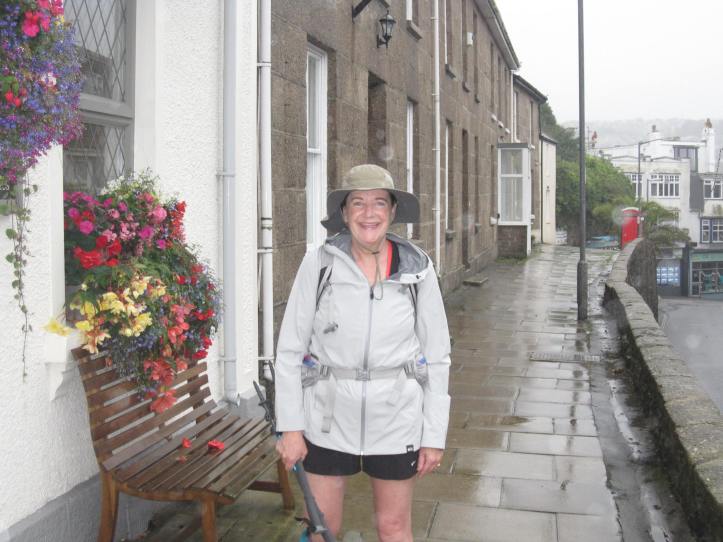 Sunday started out with something between a light drizzled and out and out rain. I realize that for the 700+ miles of walking that I have done in the United Kingdom, I have been blessed with incredible weather and very limited rain. It’s possible this trip will be payback.
 The section of the walk from St. Ives to Pendeen Watch is, according to the guidebook, a challenging one that, if it is rainy, can be something of a slog. But our spirits were high, and off we went. The path is very clear and actually paved for the first quarter mile or so out of St. Ives, easing us into the rugged, rocky miles ahead. We were both soon very glad we’d chosen to forego rain pants, because even in rain in the 60s, walking warmed us up fast.
 Because Karen and I haven’t walked together before, I’d say we both had questions: She wondered how she’d do on the long hauls (around 15 miles every day this week) and I wondered if we’d be easy companions. No worries on either count. We used the day to do some good catching up on the current state of our lives, but we share the rhythm of conversation that walking demands—sometimes you don’t talk for long stretches except to observe “muddy bit here” or “watch out for the stinging nettles” or “ooh, look at the cliffs!” To travel slowly through the countryside is to appreciate the work of good travel writers and to become painfully aware of how limited your vocabulary is for detailed description of nature. The flora along this part of the path was a mix of huge fields of ferns, mixed with a variety of evergreen bushes with thorns, patches of little blooming flowers in purple and pink and yellow, and rocks. Boulders and rocks the size of a lunch box and smaller ones, some buried in the ground so that you just walk across the surface like it was a paving stone, others requiring a bit of thought about how to place your foot to get over it. This, Karen and I heartily agreed by late afternoon, is the tiring part of walking on a rough trail as opposed to walking on paved sidewalks or on more manicured trails (like the ones I’ve been training on in the Chicago area). For long stretches, sometimes miles, every step requires a little act of calculation, muscular adjustment and little shifts in balance. If every day on this trail is like this walk, we’ll be very tired by the end. The good news is that the guide suggests that it isn’t all quite so demanding.


But it’s also stunningly beautiful, with the sound of surf nearby almost all the time, and the variations in the coastline always a source of mental stimulation, if not vivid description. Little inlets with beaches, huge dramatic bays filled with roaring surf, cliffs where the land seems to be perpetually collapsing into the sea, places where the green clings to the land even as it plunges down into the sea at 45 degrees or more. And the running water! There are so many little rivulets and streams to cross, sometimes bigger streams where bridges have been built. I am sure that some of the smaller streamlets we crossed are normally much easier to cross, and were exciting only because there has been little rain here recently and the overnight downpour and continuing drizzle couldn’t be absorbed into the soil fast enough.
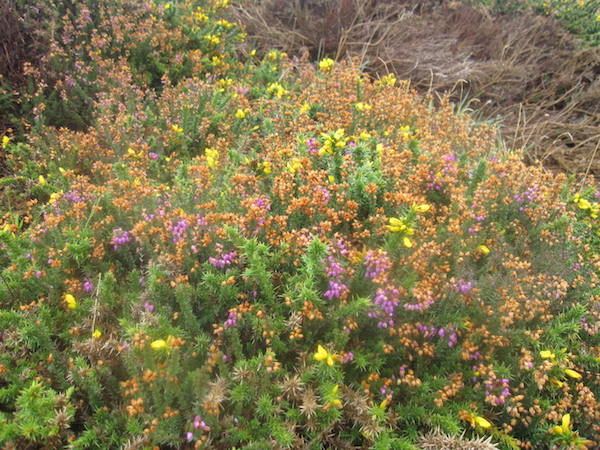
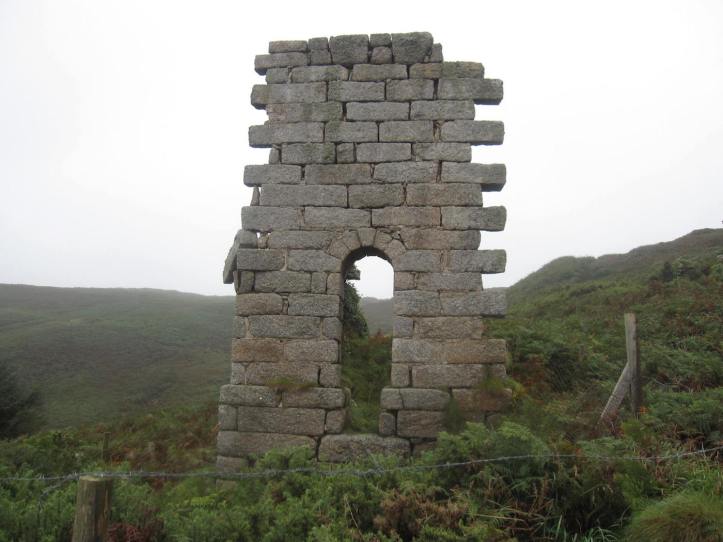
As the day continued, the drizzle eased down to periods of no rain, though I wouldn’t call it dry, since there was a constant mist in the air. This does have the advantage of keeping us cool as we perform the sweaty work of navigating the landscape. This stretch of the coast has very few inhabitants, so this was not a day punctuated with walks through little seaside towns. No, this was a walk in which we saw perhaps a dozen occupied houses all day, and passed by a number of closed mine shafts and ruined buildings from Cornwall’s days as the biggest source of tin in Europe.
We encountered maybe a dozen people all day, some walking with sneakers and without walking poles. I call them the insane ones. We were passed by a young couple from Idaho, who overtook us while we sat for a lunch break. Then we passed them about half a mile later where they had stopped for their lunch. Then another hour or so on, they passed us. They’re fit and fast and fleet-footed on the tricky rocks, which I guess you get from being from Idaho and being in your twenties. Neither of those is something I can be at this point, so I simply regard them with a mix of awe and envy. They told us at the first passing that they are going beyond Pendeen Watch to St. Just, which is a few miles further.
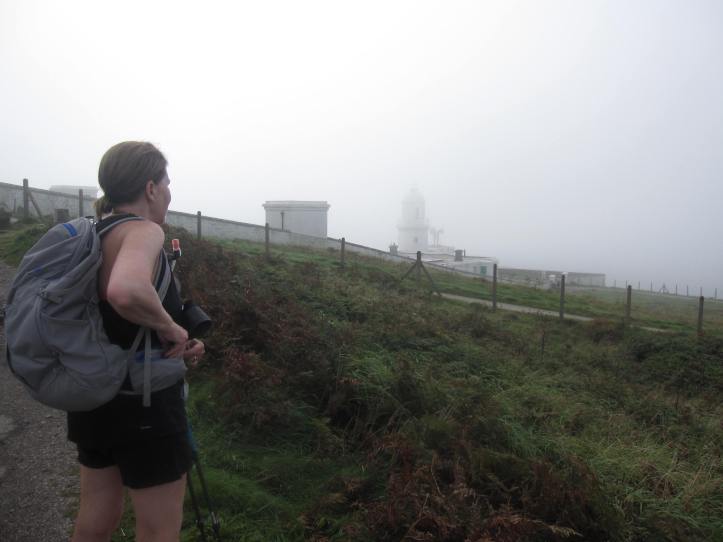
 I’ve grown used to a steady walking pace a bit faster than 3 miles an hour, but today we were reduced to something under two miles an hour. That means that when we finally saw the Pendeen Lighthouse, where we would turn inland and walk on the road for 1.5 kilometers to reach our night’s rest, we had been on the trail for eight hours and were good and properly tired. Our legs were humming with the nasty stinging chemicals from what I am guessing are stinging nettles (I am not confident about that—something we brushed past on the trail leaves you with a persistent stinging sensation that lasts into the evening. I’ve encountered this before, so I was able to reassure Karen that the low-level stinging sensation would be gone overnight). Our feet had been truly wet for hours and hours, and I could feel that my toes were pruned. Our muscles were tired and tight. But there’s a wonderful mix of exhaustion and exhilaration at the end of a challenging day.
 We got to our accommodation, a pub that does food and has a few rooms upstairs. There we found the fleet-footed Idahoans, who had cut inland to stop for a pint. They claimed to only have beaten us by about ten minutes. Karen and I agree that either they stopped at a lovely expanse of beach near the end of the day for a while, or they were diplomatically lying to us about how long they had been in the pub. They told us they had another 40 minutes of walking on the increasingly foggy roads, and we did not envy them that.
After a shower and an hour of collapse, we headed downstairs for dinner. Because it’s Sunday, they had only a ‘roast dinner’ option—beef or chicken with assorted vegetables. We both happily ate a nice chicken dinner in this very quiet pub and then retired for well-earned rest. The forecast and the three locals who were in the pub agree that tomorrow will not be rainy, though it may be cloudy and foggy. But that, combined with assurances from our host that the next part of the path is not as demanding, has me feeling ready to face tomorrow.
 ramblinghank
Hooray I get to read about your wonderful journey!! Scenery amazing, Karen you look very fit and ready for whatever the trail brings, and Hank your descriptions are lovely. Wish I was there with you…XO.
Hope tomorrow’s weather is better as you two continue on your adventure😄