A funny thing happened on the way from Hay-on-Wye to Kington: a few hours into the walk, I realized that I wasn’t thinking. I was walking, and taking photographs as the path rose into the hills, but I seem to have reached a stage, either just weariness or a deep tranquility, that doesn’t have me mulling over the state of my life or even engaging in the weird little mental games I used to amuse myself early in the walk. (On the Cotswold Way, I had a game of making up imaginary town names and then trying to come up with an etymology: Brickleton at Cresford. Hmm, what’s a brickle? And cres? In Wales, where I have actually passed through a place named Bwlch and am later staying in Cwm, the game is less fun, since any combination of l’s and w’s is probably a real town name…)

Hay-on-Wye, by the way, has the unusual distinction of hosting dozens of used-book shops. It has become the town’s calling card and tourist lure, and has in fact made it a pretty nice little town, with other nice shops growing up around the fact of all those people coming to browse for books. Kington, where I end this day of walking, is by contrast a bit more run down, with more shopfronts that seem to be selling the junk someone got out of the attic (not quaint antique shops—really junk: a broken rocking chair, five suitcases piled on top of each other, some chipped china and a set of photographs from the 1950s. They’re more like art installations than shops).

The walk rambles alongside the Wye for a while, possibly the last time I’ll see the Wye River (not sure—might hit it again later), where I stopped to try to get these swans to pose (eh), and then does what all walking trails in the U.K. do… everybody all together now: Goes up!
After the dramatic ridge walk of the last two days, with majestic views (or not in fog) from on top of the world, this day’s rolling hill country is lovely, and a nice change, but it lands in a funny intermediate category. The walk started with several days of picturesque little valleys along the Wye, often seen from above, then shifted to the Black Mountains’ windswept heights, but now there’s big long hills. Now, I should note that this is really great landscape, and I’ve been walking for two weeks, so maybe I’m getting jaded.
So, while you imagine me walking along the trail, rising up hills, going through little wooded patches and across fields of sheep and sometimes cattle, let me take a pause to meditate on the strange ways of sheep. If you’ve ever walked through a field of sheep (and who hasn’t? Am I right?), you know that they go from placidly chewing grass to looking up when they notice you to, generally, moving away, either in a calm ‘nothing to see here’ way, or in little bolts of energy if they feel like your approach is cutting off their escape routes. They will bah to alert to other sheep, and when you’ve passed, they might let out a really loud bleat as if to say “Says you, buddy,” but it’s false bravado. They’re cowards, basically. But I’ve noticed something rather hilarious and disgusting. Some of the sheep, on noting me walking by, will start to move away, and then stop and either piss or poop. Just stand there looking at me and let loose.
I’ve been working on theories to explain this, and here’s what I’ve come up with. 1) It’s part of the fight or flight instinct, and done as a preparation for fleeing. They’re getting rid of excess baggage, as it were. They see me, and their bowels and bladders just let go. Sort of plausible. 2) It’s some sort of releasing of scent thing, as if their waste is going to make some difference in whether I attack. Maybe I’m a friend, and the whiff of their musky urine or poop will make me say “Oh, it’s you, Bert. So sorry. How’s about a nice cuppa tea?” I rank this as unlikely. 3) They’re doing it to metaphorically thumb their noses at me (still lacking those opposable thumbs, eh, my little sheep nemeses?). They are moving away, but this is the moment, and it really does usually involve eye contact, when they’re saying ‘This is what I think of you with your bipedal locomotion and your fancy multi-colored wool with weird straps and zippers and things, and your opposable thumbs.” While this may not be plausible, it’s the most amusing, so I’m going with #3.
And then there’s this:
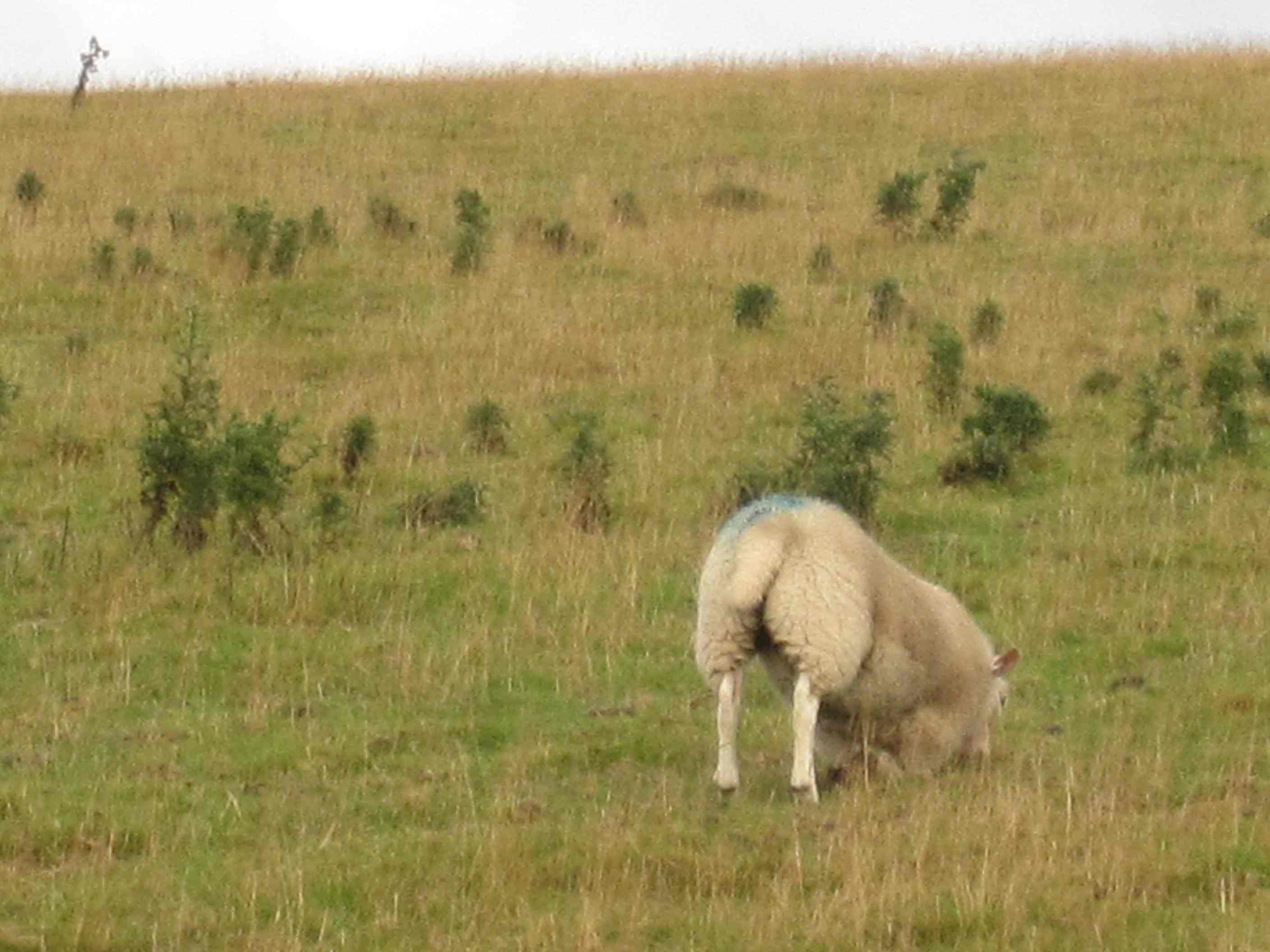
This requires some explanation. On the Coast to Coast Trail walk with my sister Tracy two years ago, at a point when we were both getting pretty punchy (I from the heavy dosing of Ibuprofin, Tracy from listening to me complain about my sore legs and watching me fuss over my bootlaces for days and days and days), we saw a sheep with its forelegs folded under, leaning down to eat. I said “downward-facing sheep,” (riffing on the yoga pose downward facing dog, for those of you not into yoga) and we both went into spasms of laughter. For several days, all it took to get us both cracking up was to say “downward-facing sheep.” So, Tracy, this is just to affirm that downward-facing sheep has made it to Wales!
A few other stray notes from the trail. First, here’s one for all my architectural expert readers (I know of at least one, but someone should get my nephew Dan hip to this blog, because he might take on this question as a homework assignment). I’ve noticed a piece of barn architecture here, which I think Tracy and I may have also encountered in some parts of the C2C, maybe in Yorkshire (?).

There are a lot of old barns with slit windows like this. So, I put it out to my readers: What’s up with the slit windows? Is there some advantage to tall narrow windows on a barn (it seems to be only barns) that leads to this? Any answers could lead to a prize, like an Offa’s Dyke Path refrigerator magnet or something.
So, a few more things about the day’s walk. The forecast had suggested some rain, but most of the day passed with clouds and sun intermixed, and no rain. Until I got to the last big hill before Kington, a slow rise over a rounded thing called Hergest Ridge. In four miles, the trial gains and then loses about 300 meters of altitude. I’ve been doing climbs like that for two weeks now, some fast and hard, and some slow and steady like this, so that isn’t a problem really. But in the clear, treeless upland fields of ferns and grass, it began to rain. Pretty heavily. Heavily enough that I saw a rainbow, while getting drenched, even though I could see blue sky just a few miles to the north.

The rain stopped after I’d come over the top, so I spent the last two miles descending into Kington as my wet clothes dried out (thank heavens for quick-drying fabric).
In my next post, a final dinner with Kathy and Keith, and the dyke, long absent from the path, returns.
Miles walked: 14.5
 ramblinghank
Surely, the slit windows are so archers can defend the barn from rebel sheep.